What every furniture inspection covers
Whatever the material, a furniture inspection follows the same core sequence. The inspector counts finished and packed goods, draws a random sample, then checks each sampled piece against the approved sample and specification.
- Quantity and packing status. How much of the order is finished and packed, by style.
- Dimensions and weight. Overall sizes, seat and table heights, drawer openings and carton sizes against the specification.
- Construction. Joinery, welds, frames, fixings and anything that carries load.
- Finish and appearance. Colour and sheen against the approved sample, scratches, runs, cracks and filler.
- Function. Drawers, doors, hinges, slides, recliners, folding mechanisms and levelling feet.
- Stability and safety. Wobble, tip-over risk, sharp edges, pinch points and loose hardware.
- Labels and documents. Warning labels, law labels, care labels and country-of-origin marks the market requires.
- Packing. Carton strength, internal protection, shipping marks and a carton drop test.
Sample sizes follow ISO 2859-1. The AQL guide explains the tables, and the AQL calculator gives the sample for your lot size. Furniture needs more time per unit than small goods, so one man-day usually covers fewer pieces.
From our inspections
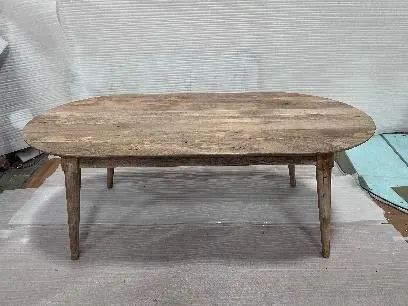
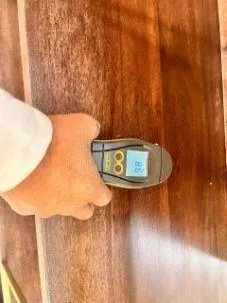
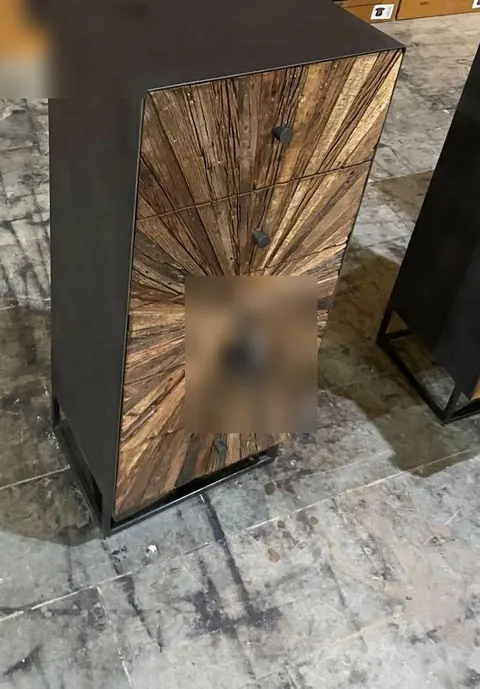
Real photos from our published sample reports, anonymised. Click a source to read the full report.
Checklist by furniture type
The core checks apply to every order. Each type of furniture then adds its own risks.
| Type | Added checks | Where defects hide |
|---|---|---|
| Solid wood | Species against the order, moisture content, joint strength, cracks and splits, knots and filler, drawer and door fit | End grain, the underside of tops, inside joints and behind back panels |
| Upholstered | Frame, springs and webbing, foam density and fill, fabric against the approved swatch, seam strength, pattern matching, flammability labels | Under the dust cover, inside cushion zips, at stress points on arms and seat fronts |
| Outdoor | Weather-resistant finish, rope or wicker tension, corrosion-resistant hardware, drainage holes, stability on uneven ground | Fixings and welds, bolt holes, joints where water collects |
| Metal and industrial | Weld quality, coating thickness and adhesion, rust, sharp edges and burrs, levelling | Inside tubes, weld seams, the underside of frames |
| Knock-down (flat-pack) | Assembly trial, hardware count against the fitting list, hole alignment, instructions, stability once assembled | Missing or wrong fittings, holes drilled off-line, panels that do not meet |
Mixed-material pieces, such as a wood top on an iron base, get the checks for each material. For the specific risks of furniture made in India, see furniture inspection in India.
Standards by market
The destination market adds legal requirements to the buyer's specification. An inspection checks the labels, documents and visible features these rules require. Tests such as stability, flammability and formaldehyde emissions are done by accredited labs; we can pull the samples.
| Market | Rule | What the inspector looks for |
|---|---|---|
| United States | STURDY Act / ASTM F2057-23 (clothing storage units) | Warning label, hang tag, tip restraint in the box, test report that matches the model |
| United States | TB 117-2013 / 16 CFR 1640 (upholstered furniture) | Federal and California flammability labels on each piece |
| United States | TSCA Title VI (composite wood) | "TSCA Title VI compliant" label on the goods or carton, panel supplier certificates |
| United States | Lacey Act (wood products) | Species and country of harvest records that support the import declaration |
| United States | 16 CFR 1303 (lead in paint) | Paint on certain furniture articles for consumer use must not exceed 90 ppm lead; the lab tests, the inspector checks that the test covers the finish used |
| European Union | EUDR (wooden furniture, from 30 Dec 2026 for large and medium operators) | Timber purchase records, species and origin documents held by the factory |
| European Union | GPSR, Regulation (EU) 2023/988 | Name of the EU-based responsible economic operator on the product, packaging or accompanying document |
| United Kingdom | Furniture and Furnishings (Fire) (Safety) Regulations 1988, amended by SI 2025/531 | Permanent labels on upholstered furniture |
| Australia | Toppling furniture information standard (mandatory since 4 May 2025) | Warning labels and anchoring information on storage furniture and entertainment units |
Many buyers also specify voluntary test standards, such as EN 12520 for domestic seating, EN 14749 for storage units and EN 581 for outdoor furniture. Solid-wood pallets and crates need the ISPM-15 mark. See all regulation guides.
Moisture content targets
Wood gains or loses moisture until it matches the air around it. Purdue University's extension guide notes that wood kept at 30% relative humidity settles at about 6% moisture content, and at 75% humidity at about 14%. A table made in a humid workshop and shipped to a centrally heated home will shrink. If it shrinks too much, tops crack, panels split and joints loosen.
That is why the target is set by the destination climate, not the factory's. The buyer states the target and tolerance in the specification. The inspector then measures with a calibrated pin or pinless meter at several points on each sampled piece, including thick parts such as legs and tops, and records every reading. Readings above the agreed limit are normally classed as a major defect.
The best time to catch wet timber is before production starts. A pre-production inspection measures the stock in the yard, when there is still time to dry it.
Packaging and drop testing
Much of the damage buyers find on arrival happens in transit, not in the factory. The inspector checks packing as closely as the product:
- Carton grade, dimensions and print against the specification.
- Corner, edge and surface protection inside the carton, and that no part can move.
- Shipping marks, barcodes and labels on the right faces.
- Hardware packs sealed, labelled and fixed inside the right carton.
- A carton drop test on a sample, usually following an ISTA procedure or the buyer's own protocol: one corner, three edges and six faces, then the product is unpacked and checked for damage.
Where goods are loaded at the factory, container loading supervision checks container condition, carton count, stacking and the seal.
Furniture inspection by country
The checks above are the same wherever furniture is made. What changes by country is the timber, the way factories work and the defects that come up most often. Clear To Load inspects in one country today. For furniture-only programmes, our sister brand Qualis Assurance offers furniture inspection at flat per-inspection fees.
| Country | Status | Page |
|---|---|---|
| India | Covered today, at any factory in the country. Main furniture clusters: Jodhpur, Saharanpur, Jaipur and Delhi NCR | Furniture inspection in India |
The India page covers the clusters, sheesham, mango and acacia, the effect of monsoon humidity on moisture, hand finishing and real inspection photos. For travel bands and notice in your factory's city, use the coverage lookup. The sample reports show the furniture report format, with the verdict on the first line: Cleared to load, Hold or Not cleared.