What makes a cane sideboard different
Weave tension, splices, spline fixing, mould and the rattan supply are covered on the cane and rattan furniture page. Level, door gaps, drawers and tip-over apply to every sideboard and are on the sideboards and buffets page. A cane sideboard puts the weave on the doors, the part that moves, and that creates its own faults.
Cane webbing is fitted wet. As it dries it shrinks and pulls tight, which is what gives a cane panel its drum-like feel. On a chair seat the frame is stout enough to resist the pull. A sideboard door frame is often only a few centimetres wide on each side, to show as much cane as possible. A slim frame can bow inward or twist as the cane tightens, so the door no longer sits flat against the carcass.
Many buyers also want a lining behind the cane, such as fabric, mesh or a thin board, so the contents are hidden and dust stays out. The lining changes how the panel looks from the front and how air moves in the cabinet. Sliding cane doors add one more risk: two woven faces passing close to each other.
From our inspections
Real photos from our published sample reports, anonymised. Click a source to read the full report.
What we check on cane sideboards
| Check | How it is checked | What fails |
|---|---|---|
| Door frame flatness | Straightedge along each rail and stile; door closed and corner gaps measured | Rails bowed inward, door twisted, one corner standing off |
| Weave alignment | Weave rows checked square to the frame and level from door to door; mesh size compared across doors | Rows running uphill, different mesh sizes on adjacent doors |
| Lining | Fixing behind the cane, even colour through the weave, no sag or wrinkles | Lining loose or wrinkled, staples showing through, uneven shade |
| Cane and frame finish | Doors compared with the approved sample in daylight, cane and wood side by side | Cane much lighter or darker than the frame, patchy stain on the cane |
| Edge trim and staples | Inside face of each door checked where webbing is wrapped or stapled | Sharp or proud staples, frayed cane ends, trim loose |
| Sliding doors | Doors run past each other end to end | Cane on one door rubbing the other, broken strands at the meeting point |
| Inside the cabinet | Smell and visual check after the doors have been closed; moisture reading on shelves | Musty smell, spots on shelves or the back of the cane |
Common cane sideboard defects and how they are classed
| Defect | Class |
|---|---|
| Live mould on cane or inside the cabinet | Critical |
| Sharp staple on the inside face of a door | Major |
| Door frame bowed by cane tension, door not flush | Major |
| Broken strands on a door face | Major |
| Cane colour clearly off the frame or approved sample | Major |
| Lining loose or sagging behind the cane | Major |
| Weave rows slightly out of line between doors | Minor |
| Standing cane fibres on a door face | Minor |
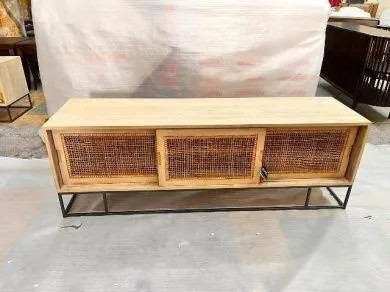
Our Sample 01 report (Jodhpur, November 2022) included a sideboard with woven panels, which had one minor finding for visible nails. The report does not record the weave material or where the nails were, but the inside face of woven doors, where webbing is wrapped and fixed, is a common place to look.
Market rules that apply
- Australia. Sideboards 686 mm or taller need a permanent toppling warning label. On a cane-fronted unit it usually goes inside a door or on the carcass. Wood and plant material also meet biosecurity conditions; see importing into Australia.
- US, Lacey Act. The wooden frame and the cane are both plant products. Record the species of each. See Lacey Act.
- EU, EUDR. A cane sideboard with a wooden carcass is usually classed as wooden furniture; check the customs code with your broker. See EUDR.
- Linings and panels. A plywood or MDF backing board behind the cane brings in TSCA Title VI for the US. Anti-mould treatments must comply with REACH.
Packing, transit and loading risks
- Point loads on doors. The cane door is the weakest face of the carton. A rigid board across the full front stops corners and straps pushing into the weave.
- Closed cabinet, damp cane. A sideboard is a closed box with cane on the outside. If the cane was still damp from fitting or the monsoon, moisture is trapped inside with the wrap. Check that cane is dry before packing.
- Doors moving. Doors should be held closed with soft ties, not tape on the cane, which pulls fibres when removed.
- Sliding doors. Remove them or wedge them, so they do not rub across each other for weeks.
What to put in your purchase order
- Natural or synthetic cane, mesh pattern and size, the same roll or batch for all doors of one unit.
- Minimum door frame section, and maximum bow or twist of a fitted door.
- Weave orientation: rows square to the frame and level across doors.
- Lining material, colour and fixing, if any.
- Finish on cane and frame approved together on one sample.
- Inside fixing: staples covered, cane ends trimmed and sealed.
- Moisture limit and a rule that goods are dry before packing.
For other sideboard materials, see wooden sideboards and bone inlay sideboards.