How wardrobes are made for export
A wardrobe is the largest single piece most Indian furniture factories export. A two-door solid-wood unit can be close to two metres tall and well over 50 kg. To fit it into a carton and a container, most are built knock-down: sides, top, base, back and doors made as separate panels that the customer bolts together with cam fittings, dowels or bolts.
That shifts the quality risk. The factory may assemble one unit to check the design, then pack hundreds without ever putting them together again. A drilling jig that drifts, a door hung on a different hinge, or a hardware bag that misses two cams shows up only in the customer's bedroom.
Doors are the other weak point. Solid-wood or framed doors with cane or woven panels are heavy, and they hang from two or three hinges screwed into the edge of a side panel. If the hinge or the screw fixing is weak, the door drops at the free corner and stops closing flush.
From our inspections
Real photos from our published sample reports, anonymised. Click a source to read the full report.
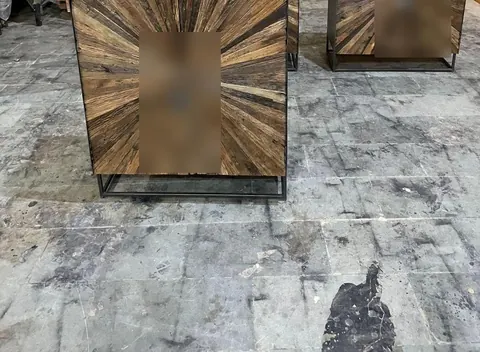
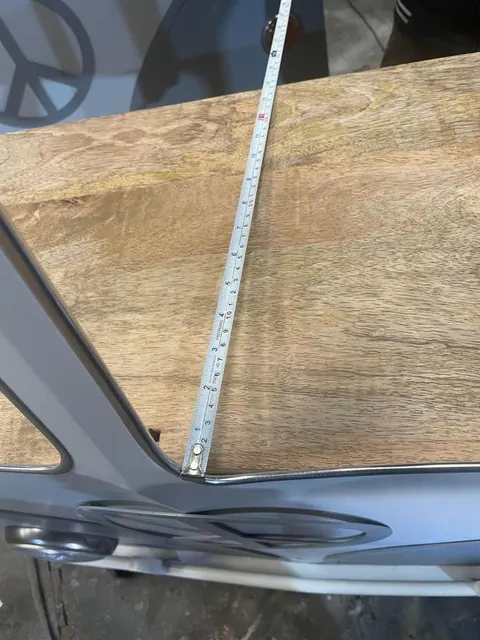
What we check on wardrobes
| Check | How it is checked | What fails |
|---|---|---|
| Assembly trial | Assemble sampled units using only the box contents and instructions | Missing or wrong fittings, holes that do not line up, panels that do not meet |
| Door alignment and sag | Check gaps at top, middle and bottom; open and close 20 times; re-check gaps | Uneven gaps, door rubs or drops, top edges not level |
| Hinges | Hinge type and count against the PO; screw length and fixing; adjustability | Fewer hinges than specified, short screws in board edges, stripped holes |
| Hanging rail | Hang the load the buyer sets at mid-span; check sag and bracket fixing | Rail bends, brackets pull out, rail too short for its sockets |
| Tip-over items | Check the warning label, tip-restraint kit and test report against the model | Label missing or wrong place; no restraint kit; report for a different model |
| Door mirrors and glass | Check fixing, edges and backing | Loose mirror, chipped edge, no backing where the PO requires it |
| Locks and handles | Operate every lock and key; check handle bolts | Key does not turn, loose handles |
Common wardrobe defects
| Defect | Typical class | Notes |
|---|---|---|
| No tip restraint or no warning label on a US unit in scope | Critical | A legal requirement under 16 CFR 1261 |
| Unit cannot be assembled from the box contents | Critical or major, as the buyer sets | The customer cannot use it |
| Door sags or rubs after repeated opening | Major | Gets worse with use |
| Hanging rail bends or pulls out under load | Major | Main function fails |
| Warped door or side panel | Major | Doors will not close flush; often from wet timber |
| Uneven door gaps within tolerance; finish marks | Minor | Cosmetic |
For tall storage, keep the dimension check tight. In Sample 01, a 190 cm woven-panel cupboard measured within 2 mm of the PO, and the report records its weight, 52.15 kg. Both figures matter if a tip-over test report is tied to that model.
Market rules: STURDY, toppling and storage standards
- US. The STURDY Act rule (16 CFR 1261, adopting ASTM F2057-23) covers free-standing clothing storage units, including wardrobes, made from 1 September 2023 that are at least 27 in tall, 30 lb and 3.2 cu ft of enclosed storage. Most wardrobes meet all three. Each needs a passing stability test, a permanent warning label and a tip restraint that meets ASTM F3096 packed with it. Interlocks, where used, must engage without consumer action and must not need consumer assembly on a unit shipped assembled.
- Australia. Clothes storage units 686 mm or taller are in Category 1 of the Toppling Furniture Information Standard 2024 and need permanent warning labels with anchoring messages. See Australia.
- EU. EN 14749:2016+A1:2022 covers domestic storage furniture, and SATRA notes its impact requirement for non-backed glass in external vertical surfaces such as doors, which matters for mirror doors. Buyers apply it under the GPSR.
- Panels and wood. TSCA Title VI for MDF and plywood in the US; EUDR and the Lacey Act for wood.
Packing a knock-down wardrobe
A knock-down wardrobe often ships in two or three cartons. If one carton is short-shipped or split from its set, the customer has nothing usable. We check that every carton is marked with the set number (for example 1/3, 2/3, 3/3), that the counts match per set, and at loading that all cartons of a set go into the container. Inside, door panels need full-face protection and corner blocks. Mirror doors need board on both faces and a glass mark on the carton. The hardware bag, instructions, warning label and tip restraint should be in a named carton, listed on the carton label.
What to put in your wardrobe PO
- Model number tied to its ASTM F2057-23 test report, with tested height, depth and weight.
- Hinge make, type and number per door; screw length; maximum door gap.
- Hanging rail diameter, material and the load it must hold.
- Fitting list, instructions and which carton holds them.
- Warning label artwork and position for each market.
For wardrobes going to the US, book an inspection and attach the test report so the inspector can check the goods against it.
Sources
- 16 CFR Part 1261, Safety Standard for Clothing Storage Units (eCFR)
- CPSC: Clothing Storage Units business guidance
- Federal Register, Safety Standard for Clothing Storage Units (doc. 2023-08997)
- Consumer Goods (Toppling Furniture) Information Standard 2024 (F2024L00512)
- EVS: EN 14749:2016+A1:2022 (abstract)
- SATRA: Glass in furniture