How solid wood furniture is made in India
Export furniture in solid wood comes mainly from three places. Jodhpur in Rajasthan, which an Export Promotion Council for Handicrafts (EPCH) bulletin describes as a declared mega cluster of wooden handicrafts, makes sheesham, mango and acacia furniture, often combined with iron. Saharanpur in Uttar Pradesh is known for carved wood; "Saharanpur Wood Craft" is a registered Geographical Indication, and the craft favours sheesham and teak. Jaipur makes painted and carved pieces.
A typical order moves through four stages, and each one can go wrong:
- Timber buying. Logs or sawn planks are bought from timber merchants, depots and auctions. Factories rarely fell their own trees, so species and dryness depend on the merchant.
- Seasoning. Planks are air-dried in the yard, then dried in a kiln if the factory has one or rents kiln time. When kiln time is short, part-dried timber can reach the bench.
- Panel glue-up and joinery. Wide tops are edge-glued from narrow strips. Frames are joined with mortise and tenon, dowels or bolts, often by hand.
- Finishing. Sanding, filling, staining and lacquer, wax or oil, mostly applied by hand in open sheds.
Species-specific risks are covered on the sheesham, mango and acacia pages. This page covers what applies to all solid wood.
From our inspections
Real photos from our published sample reports, anonymised. Click a source to read the full report.
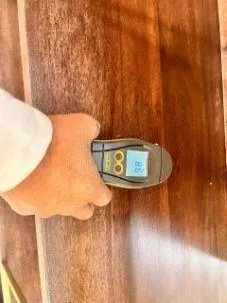
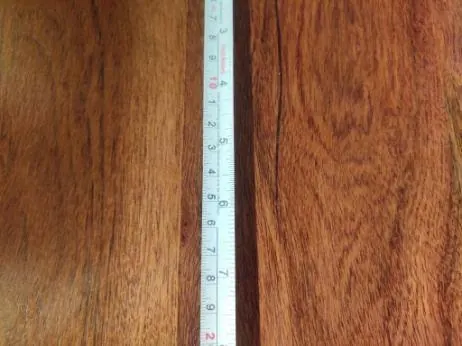
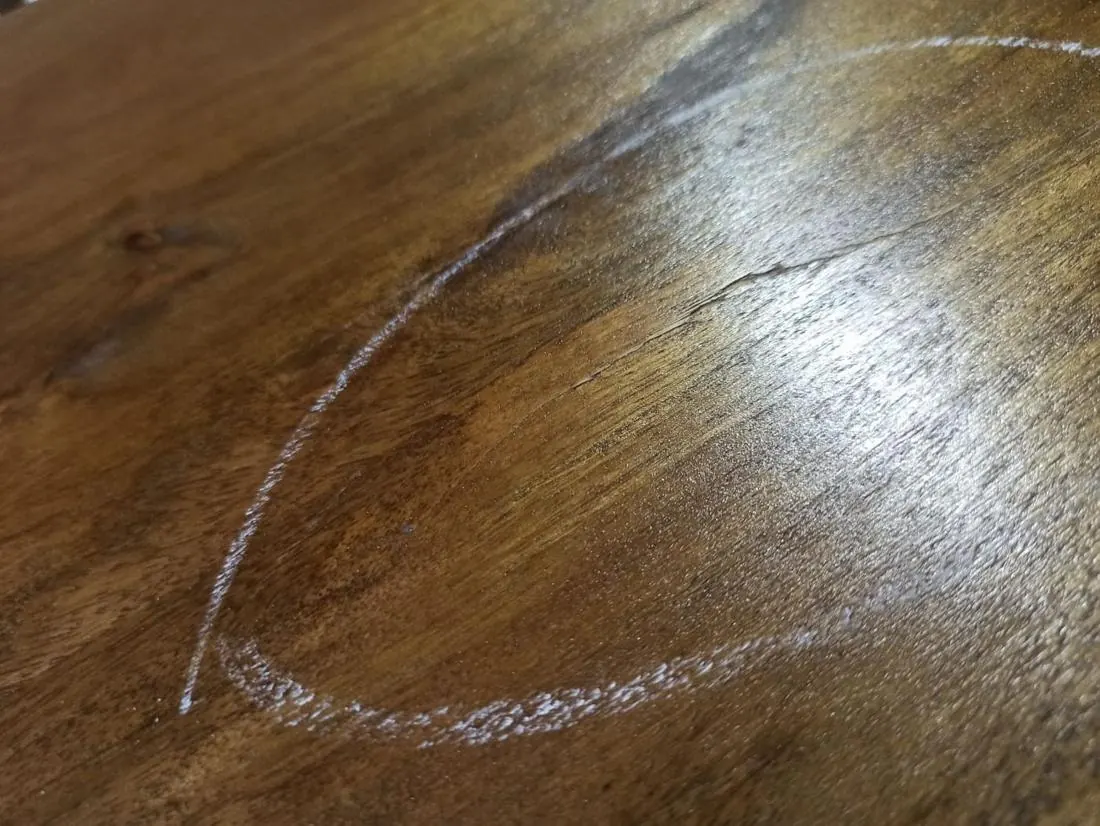
What we check on solid wood furniture
| Check | How it is checked | What fails |
|---|---|---|
| Moisture content | Calibrated pin meter, species setting, readings on legs, tops and frame rails, taken on an unfinished face where possible | Any reading above the buyer's limit (default 11%) |
| Solid vs composite | Look at edges, backs, drawer bottoms and the underside; tap test; drill hole or edge inspection where agreed | Plywood, MDF or particleboard in a part specified as solid wood |
| Cracks and splits | End grain of tops and legs checked under raking light; glue lines of edge-glued panels flexed by hand | Open end cracks, glue-line separation, cracks hidden under filler |
| Filler and repairs | Finished surface checked at arm's length and close up | Visible epoxy, putty or wood-dust filler that shows in colour or texture |
| Joinery | Racking test on chairs and tables by hand, joints inspected for gaps and glue starvation | Movement in joints, gaps, missing dowels or bolts |
| Movement allowance | How tops are fixed to frames: slotted holes, buttons or fixed screws | Tops screwed tight across the grain with no room to move |
| Dimensions and flatness | Tape and straightedge against the specification; tops checked for cup and twist | Out of tolerance, or tops that rock on a flat floor |
Moisture is measured on finished pieces at pre-shipment, but the cheaper time to catch it is in the yard. A pre-production inspection measures the stock before it is cut, while there is still time to dry it.
Common solid wood furniture defects and how they are classed
These are real findings from our anonymised sample reports and typical solid wood defects. The class follows the buyer's defect list; where none is given, we use the classes below.
| Defect | Typical class | Why |
|---|---|---|
| End crack in a table top | Major | Found on an oval dining table top in Jaipur (Sample 03); cracks grow in dry, heated homes |
| Visible epoxy (araldite) filling | Major | Also Sample 03: the filler hid a defect but showed through the finish |
| Badly filled cracks | Major | Found on wooden TV units in Jodhpur (Sample 04) and rectified on site |
| Crack in a cabinet that stops a shelf sitting level | Major | Sample 04, Jodhpur |
| Moisture above the agreed limit | Major | Leads to shrinkage, loose joints and cracks after arrival |
| Structural crack in a load-bearing leg or rail | Critical | Can fail in use and injure the user |
| Grinding or sanding marks on the surface | Minor | Found on a solid wood dining table in Jodhpur (Sample 01) |
| Open knot, small glue squeeze-out, uneven sheen | Minor | Cosmetic, unless the specification asks for knot-free timber |
The verdict reads Cleared to load, Hold or Not cleared against the AQL. One crack in a load-bearing part is enough to fail a lot.
Market rules that apply to solid wood
- United States, Lacey Act. The import declaration needs the scientific name of every wood in the piece and the country where it was harvested. Imported pine or oak used in India is declared with its own country of harvest, not India.
- European Union, EUDR. Wooden furniture needs a due-diligence statement with the geolocation of the plots where the timber grew, from 30 December 2026 for large and medium operators.
- United States, TSCA Title VI. Solid wood itself is not covered, but a plywood back or MDF drawer bottom makes the piece a regulated finished good that needs certified panels and a label.
- Finishes. Lacquers and stains fall under EU REACH and California Proposition 65; lead in paint on US consumer furniture is limited by 16 CFR 1303.
- Storage furniture. Chests and wardrobes for the US fall under the STURDY Act; tall units need tip-over checks in every market.
- Packing. Solid wood pallets and crates need the ISPM 15 mark.
Packing, transit and loading risks
Solid wood keeps moving after it is packed. A container can sit in high humidity for weeks and then arrive in a heated warehouse. Three checks reduce damage:
- Packing dry goods. Pieces that were washed, oiled or lacquered the day before are sealed in plastic with moisture trapped inside, which can cause mould and finish blooming. We check that the finish is cured before packing.
- Corner and edge protection. Heavy solid tops crush carton corners. Drop tests show whether the protection holds the weight.
- Loading. Heavy cartons go at the bottom, and no carton should carry a load on an unsupported top. Loading supervision checks stacking, the container's condition and the seal.
What to put in your purchase order
- Species by component, with the scientific name, and a statement of which parts (if any) may be plywood or MDF.
- Moisture target and limit for your market, and at what stage it is measured. Our default reference is 8–11%, with a limit of 11%.
- Filler policy: whether any filler is allowed on visible faces, and what colour match is acceptable.
- Knots, grain and sapwood: what is accepted on tops and fronts, ideally with a photo standard.
- Dimension tolerances. Without them, deviations can only be reported, not judged, as in Sample 01.
- An approved sealed sample for colour and sheen, kept at the factory.
- Records: timber purchase invoices and species declarations for Lacey and EUDR.
To add these checks to your next order, book an inspection. Prices are on the pricing page.
Sources
- EPCH, Jodhpur thematic display (Jodhpur declared a mega cluster of wooden handicrafts)
- Geographical Indications Registry: Saharanpur Wood Craft (application 184)
- Office of the Development Commissioner (Handicrafts): Saharanpur Wood Craft
- 40 CFR Part 770, Formaldehyde Standards for Composite Wood Products (eCFR)
- Regulation (EU) 2023/1115 (EUDR), EUR-Lex