What makes a marble coffee table different
Crack detection, fills, colour range and crating of stone are covered on the marble and stone top furniture page. Glass tops, lift-tops and coffee table height are on the coffee tables page. A marble coffee table brings its own risks:
- Thin stone, wide span. To keep weight down, coffee table tops are often thinner than dining tops. A thin top resting on a narrow pedestal, or only on a perimeter frame, carries a person's weight on an unsupported span. That is where tops crack in use.
- Point contact. A welded iron frame that is slightly twisted touches the stone at three points. The fourth corner hangs. Under load, the stone bends over the high point.
- Edge loading. People push on the edge to stand up from a sofa, children climb on it, and some sit on it. A heavy top on a small central base can lift on the far side.
- Sets. Round coffee tables are often sold as nesting pairs. Two tops from different slabs look wrong side by side.
Weight adds up fast. Marble is roughly 2.7 tonnes per cubic metre, so a 120 × 60 cm top at 2 cm thick weighs about 39 kg before the base.
From our inspections
Real photos from our published sample reports, anonymised. Click a source to read the full report.
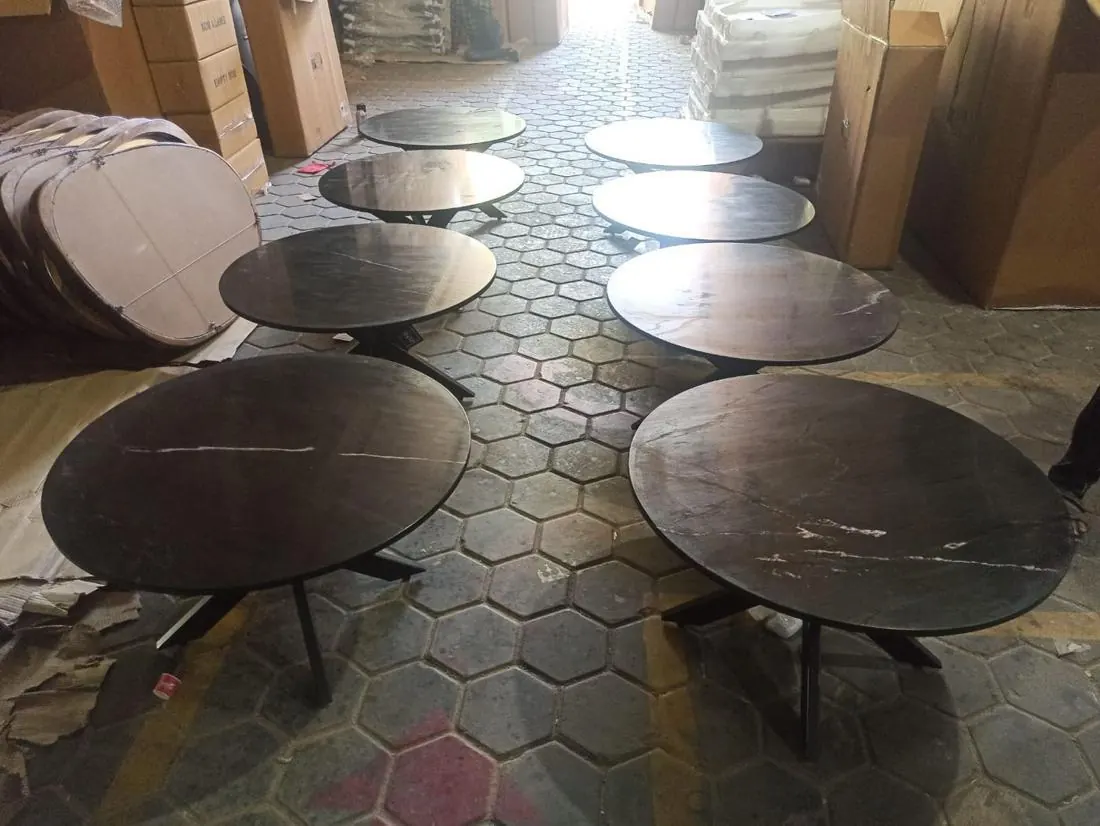
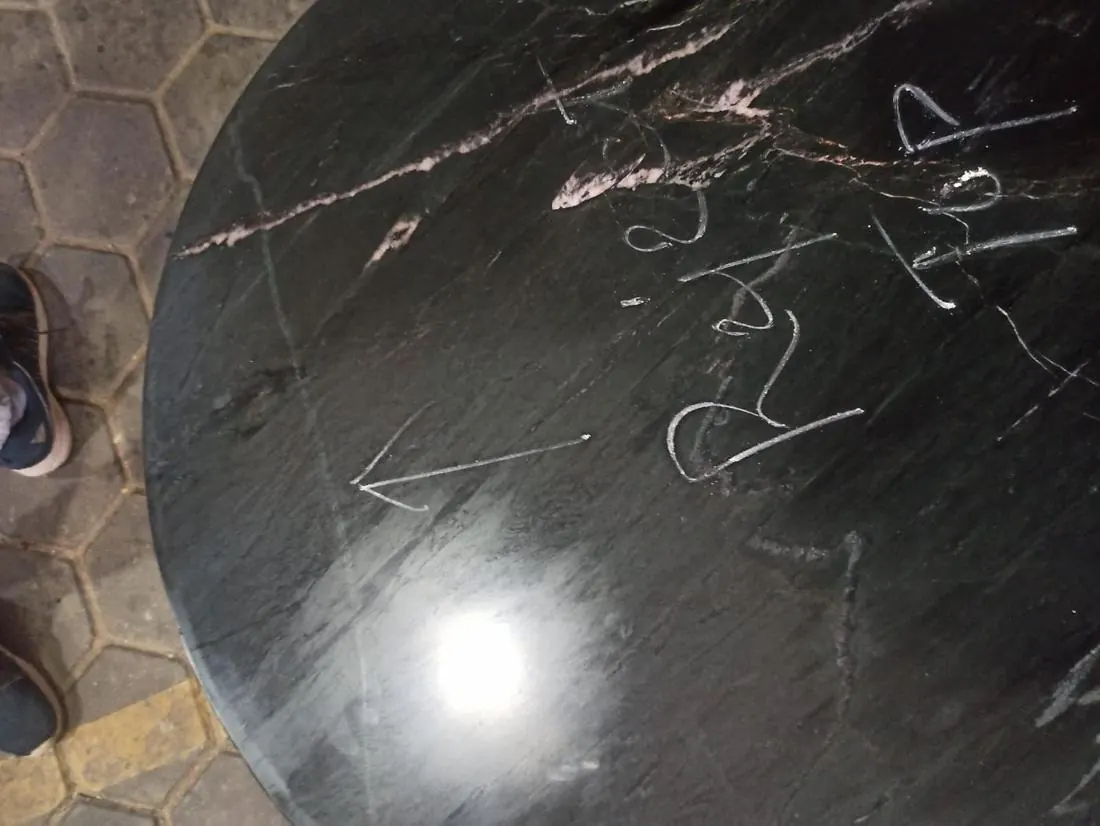
What we check on marble-top coffee tables
| Check | How it is checked | What fails |
|---|---|---|
| Thickness for the span | Calipers at each edge; unsupported span measured from base to edge | Top thinner than ordered, or a span longer than the approved design |
| Even support | Top set on its base; feeler gauge between stone and each pad or frame rail | Gap at one corner, top rocking on the frame, missing pads |
| Edge-load tip | Downward push at the edge furthest from the base, or the buyer's load, on a level floor | Opposite side lifts; top slides on the base |
| Edge profile and corners | Profile against the drawing; corner radius gauged | Sharp arris or square corners where an eased edge or radius was ordered |
| Set matching | Nesting or paired tops laid side by side under daylight | Different background colour or vein style within a set |
| Seal and etch | Water drop, and an agreed mild acid test on a hidden spot or offcut | Water darkens the stone quickly; buyer not told that acid will etch |
| Locating method | Pins, recesses, adhesive pads or brackets checked against the drawing | Top only resting by gravity where a fixing was specified |
| Packed weight | Carton or crate weighed against the specification | Gross weight above your limit for handling or parcel delivery |
Sealing stops stains from soaking in. It does not stop etching. Marble is calcium carbonate, and lemon juice, wine or some cleaners dull a polished surface in minutes. A coffee table sees more drinks than most furniture, so put care advice in the box.
Common marble-top coffee table defects and how they are classed
| Defect | Class |
|---|---|
| Top lifts or slides off the base under edge load | Critical |
| Crack in the top | Major |
| Top thinner than ordered | Major |
| Top rocks on the base or bears on three points | Major |
| Mismatched tops in a nesting pair | Major |
| Sharp corner where a radius was ordered | Major |
| Missing pads between stone and metal frame | Major |
| Dull polish patch or swirl marks | Minor |
Cracked marble tops were a real finding in our Sample 04 report: two black marble tables were marked for replacement, while two marble dining table styles in the same order passed. Crack risk varies by style and by slab, so sample every style.
Market rules that apply
- European Union. Under the GPSR, a heavy top that can tip or slide off is a safety issue, and the instructions should warn about it. EU buyers often specify EN 12521 for domestic tables; see EN furniture testing.
- Crates. Solid-wood crates and pallets need the ISPM 15 mark. Plywood and other processed wood are exempt.
- Bases. A wooden base brings in the Lacey Act and EUDR. A painted or powder-coated metal base falls under the US lead-in-paint limit; see CPSC and CPSIA rules.
- Australia. Coffee tables are not in the toppling furniture categories, but the general safety duty still applies. See Australia furniture standards.
Weight, packing and transit
- Carton or crate. Small tops often ship in heavy cartons with honeycomb board; larger ones need a crate. Decide by weight and by how the goods reach the customer.
- Top and base apart. The base should not travel bolted to a thin top, where a drop on the base levers the stone.
- Nesting pairs. Both tops in one carton need a rigid separator, not just foam sheet.
- Drop test. A corner drop, then the top unpacked and checked under raking light. Cracks from a drop often start at a corner.
- Handling marks. Gross weight, two-person lift and this-way-up marks on every carton.
What to put in your purchase order
- Stone thickness with a tolerance, and the maximum unsupported span.
- Support: pads or a full board, and how many contact points.
- Fixing between top and base, and the edge-load check you want.
- Edge profile and corner radius, with a drawing.
- Set rule: nesting or paired tops cut from the same slab.
- Sealer, and care advice on etching in the box.
- Maximum gross weight per carton, and crate or carton spec.
Similar tables in other materials: metal coffee tables and wooden coffee tables. To check stone before it is crated, book an inspection.