A real tip-over finding
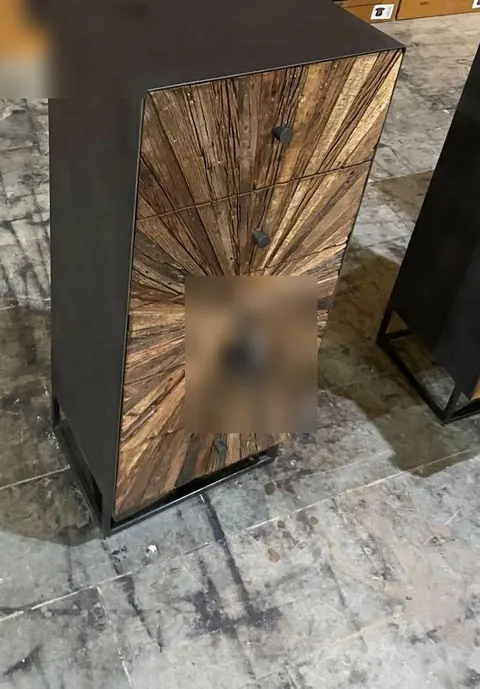
In January 2023 we inspected 465 pieces of mango wood and reclaimed-wood furniture in Jodhpur. One style was a five-drawer cabinet in wood and iron. With all drawers open, it tipped forward. The design had no provision for an anti-tip kit. The inspector recorded it as a critical defect, and the lot was Not cleared on that finding alone. The full report is Sample 05.
That is the typical shape of the problem in Indian chests. Solid timber is heavy, drawers are often deep and run on full-length wooden runners, and the top drawers carry weight high up. When every drawer comes out at once, the centre of gravity moves forward past the front feet.
From our inspections
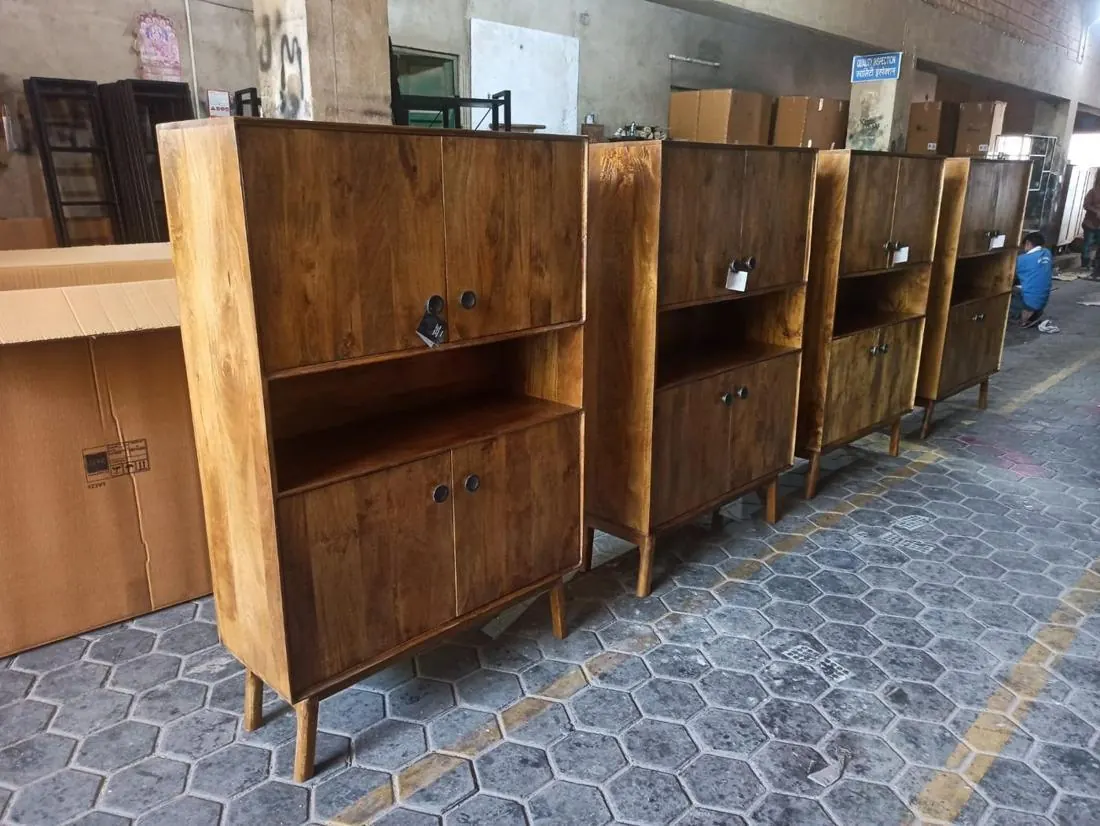
Real photos from our published sample reports, anonymised. Click a source to read the full report.
Drawers, runners and stops
Drawer construction drives both quality and stability. Indian factories use three common systems: wooden side runners with a waxed slide, a central wooden runner under the drawer, or bought-in metal ball-bearing slides. Each needs a different check.
- Wooden runners swell in humid weather and shrink in heated rooms. The inspector checks drawer clearance and how the drawer runs; a drawer that is tight at the factory may jam on arrival, and one that is loose may tilt down when opened.
- Stops decide how far a drawer extends. A missing stop lets a heavy drawer fall onto feet, and a stop fitted further back than on the tested unit lets the drawer extend more, which changes the stability result.
- Metal slides must match the tested type. Full-extension slides bring the drawer further forward than three-quarter slides.
- Drawer boxes: joints (dovetail, rebate, nailed), bottom panel thickness and fixing, and handles bolted through, not just screwed into the front.
What we check on chests of drawers
| Check | How it is checked | What fails |
|---|---|---|
| Warning label | Present, permanent, legible and in the position shown on the label artwork | Missing, loose or wrong text |
| Tip restraint | Kit in the carton, parts against the list, fixing point on the unit | No kit, missing parts, no fixing point |
| Interlock | Open one drawer and try to open a second; check it works without the user setting it | Second drawer opens; interlock needs assembly on a unit shipped assembled |
| Drawer extension | Measure each drawer's travel to its stop and compare with the tested unit | Extends further than the tested unit; no stop |
| Field tip screen | On a level floor, open all drawers, empty, and observe | Unit tips or the rear lifts |
| Model match | Height, depth, weight and photos against the test report | Unit differs from the tested model |
| Drawer running | Open and close each drawer; check gaps and squareness | Sticks, tilts, rubs, uneven gaps |
Defect classes for chests of drawers
| Defect | Typical class |
|---|---|
| Unit tips forward with drawers open | Critical |
| Missing warning label or tip restraint on a US unit in scope | Critical |
| Interlock that fails or can be bypassed in normal use | Critical |
| Drawer with no stop, or extension greater than the tested unit | Major |
| Drawer that jams, tilts or has a loose bottom | Major |
| Crack in a side or top; split drawer front | Major |
| Uneven drawer gaps, finish marks, loose handle screw | Minor |
Market rules for chests and dressers
The STURDY Act page covers the US rule in full. In short, 16 CFR 1261 makes ASTM F2057-23 mandatory for free-standing clothing storage units made from 1 September 2023 that are at least 27 in tall, 30 lb and 3.2 cu ft of enclosed storage. CPSC's guidance describes tests with drawers open and loaded, a 10 lb horizontal force, and a 60 lb load hung on an open drawer with the unit tilted to simulate carpet. Interlocks must keep a drawer closed under a 30 lb pull for 5 seconds. The tip restraint must meet ASTM F3096.
Australia puts clothes storage units 686 mm or taller in Category 1 of its Toppling Furniture Information Standard 2024, with permanent warning labels. EU buyers usually specify EN 14749:2016+A1:2022 for domestic storage under the GPSR. Finishes fall under Prop 65 and REACH; wood under the Lacey Act and EUDR.
Packing and what to put in your PO
In transit, drawers slide out and hammer the carcass unless they are blocked. We check that each drawer is taped or wedged shut with protection under the tape, that handles are wrapped or packed separately, and that the tip restraint and label instructions are inside the carton, not left at the packing table.
- Model number tied to its test report, with height, depth, weight and drawer extension.
- Runner type and stop position per drawer.
- Interlock make and model, if the design uses one.
- Warning label artwork and position; tip-restraint kit parts list.
Send the test report with your booking so the inspector can check the goods against the tested unit.
Sources
- 16 CFR Part 1261, Safety Standard for Clothing Storage Units (eCFR)
- CPSC: Clothing Storage Units business guidance
- Federal Register, Safety Standard for Clothing Storage Units (doc. 2023-08997)
- Consumer Goods (Toppling Furniture) Information Standard 2024 (F2024L00512)
- EVS: EN 14749:2016+A1:2022 (abstract)