How TV units are made in India
Most TV units bought from India are long, low cabinets: a solid wood or wood-and-iron carcass, two to four doors or drawers, an open shelf for a console or receiver, and a back panel in plywood, MDF or solid boards. Jodhpur workshops build many of them in sheesham, mango or acacia, often with iron legs or frames. Other ranges use woven, cane or slatted door panels, or carved fronts.
Three details set a TV unit apart from other cabinets:
- Cable routing. Holes or slots in the back panel and shelves are cut by hand router or drill, often after assembly. Their size and position drift from unit to unit unless the factory uses a jig.
- Handle-free fronts. Many designs use push-to-open latches or soft-close hinges bought in as hardware. They only work if the door gap and latch depth are right.
- A heavy, concentrated load on top. A screen, a soundbar and a console sit on a top that may span well over a metre between supports.
From our inspections
Real photos from our published sample reports, anonymised. Click a source to read the full report.
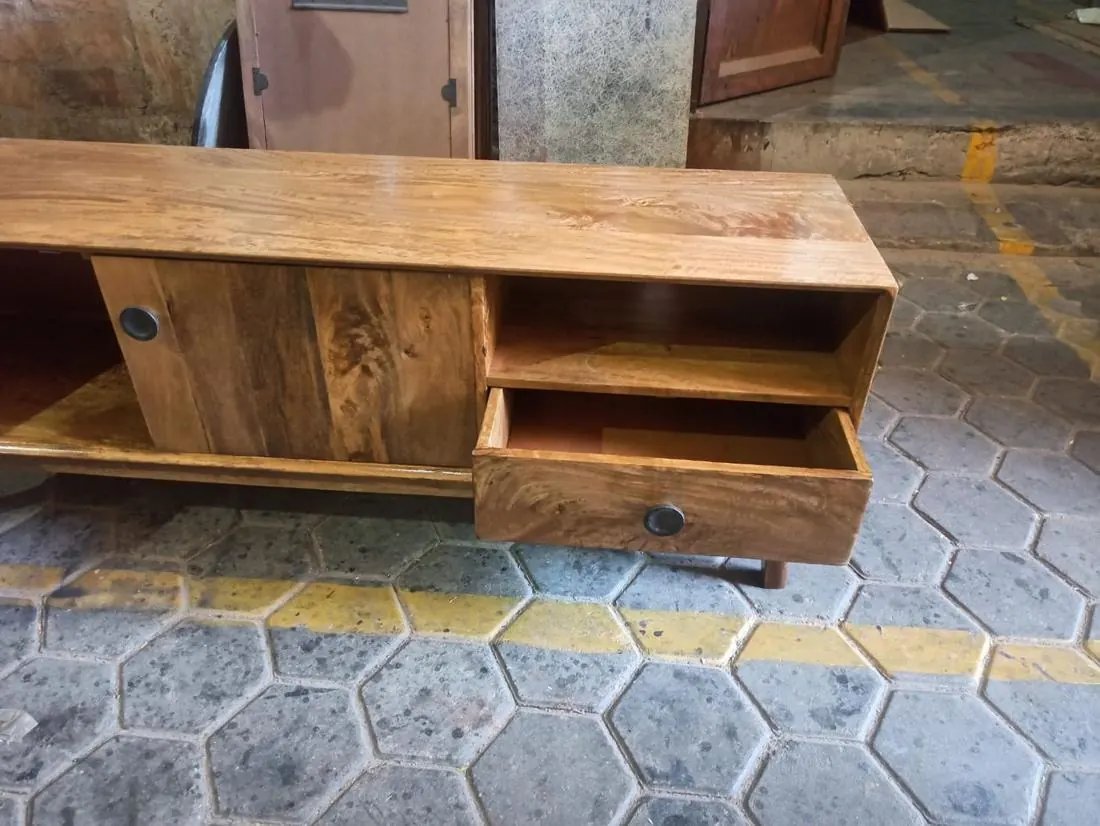
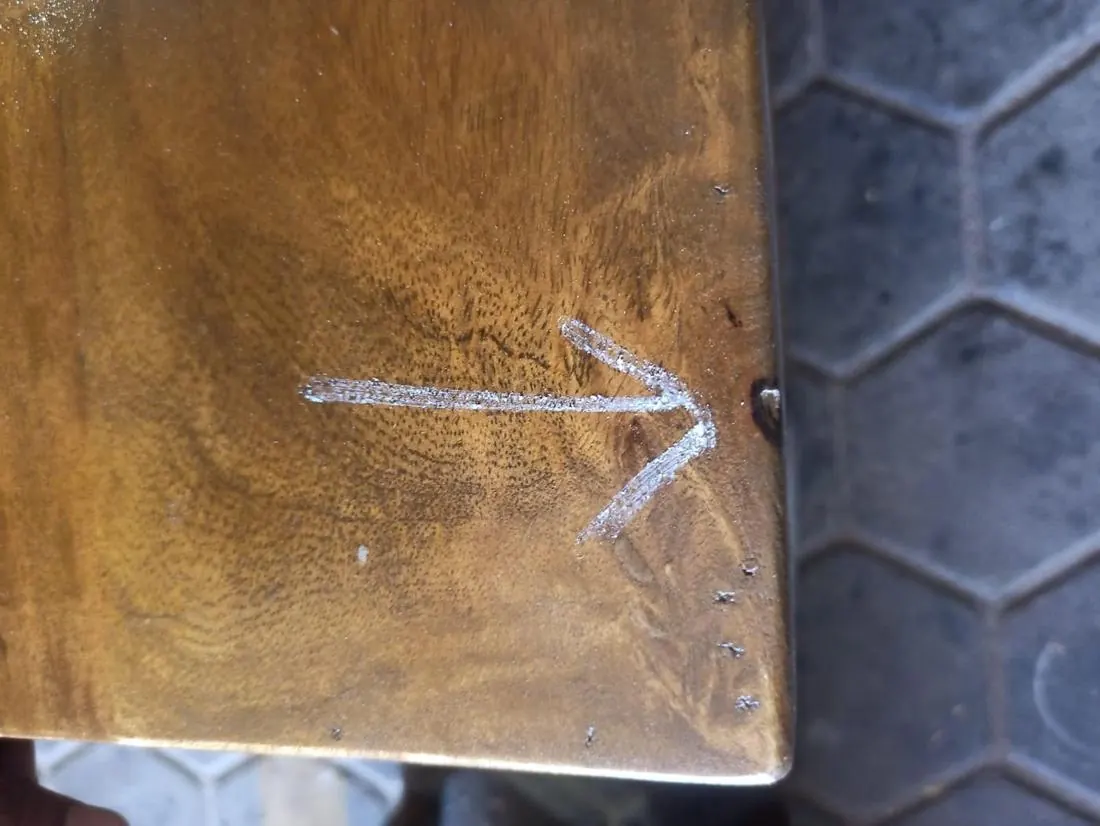
What we check on a TV unit
| Check | How it is checked | What fails |
|---|---|---|
| Top flatness and load | Straightedge across the top; the load you specify placed at the centre, deflection measured before and after | Visible sag, a top that rocks on the carcass, or deflection beyond your limit |
| Cable cut-outs | Size and position measured against the drawing; edges felt and inspected | Missing or misplaced holes, rough or splintered edges that would cut a cable, open MDF edges |
| Doors and gaps | Gap gauge on every door; doors opened and closed with and without load on top | Uneven or tapered gaps, doors that rub, catch or will not stay closed |
| Push-to-open latches | Each latch pressed several times; release and re-latch checked | Doors that spring open on their own, need a hard push, or do not latch |
| Glass | Type and thickness against the specification, edge finish, fixing clips or beads, any marking | Untoughened glass where toughened is specified, sharp edges, loose or rattling panes |
| Stability and anchoring | Unit pushed at the top on a flat floor; drawers opened; anti-tip kit counted against the fitting list | Rocking, easy tipping with drawers open, missing anchor kit or instructions |
| Back panel | Fixing points checked by hand; panel material confirmed | Loose or bowed panel, too few fixings, undeclared MDF or plywood |
On top of these, every TV unit gets the core furniture checks: dimensions, moisture content, finish against the approved sample, labels and packing. See how to inspect furniture before shipping.
Common TV unit defects and how they are classed
| Defect | Usual class | Why |
|---|---|---|
| Unit tips easily, or no anchor kit where the buyer or market requires one | Critical | Risk of injury, especially to children |
| Glass with sharp edges or not the specified safety glass | Critical | Risk of cuts if broken or handled |
| Top sags under the specified load | Major | Screen sits unevenly; worsens in use |
| Cable cut-out missing or in the wrong place | Major | The unit cannot be used as sold |
| Push latch or hinge not working | Major | Function failure the customer sees at once |
| Cracks or poor crack filling | Major | Opens further in dry, heated rooms |
| Uneven door gaps within tolerance limits, minor finish marks | Minor | Cosmetic, within buyer's limits |
Two of our real reports involve media furniture. In Sample 04 three wooden TV units had badly filled cracks, recorded as major and rectified on site. In Sample 02 a three-door media cabinet had an improper finish, recorded as minor. Agree the class of each defect in your inspection plan before the visit; the AQL guide explains how the classes are counted.
Market rules that apply to TV units
TV units fall outside the US STURDY Act: 16 CFR 1261 excludes entertainment furniture. Other rules still apply.
| Market | Rule | What it means for a TV unit |
|---|---|---|
| Australia | Consumer Goods (Toppling Furniture) Information Standard 2024, in force since 4 May 2025 | Entertainment units are covered at any height: permanent warning label on the unit and safety information for the buyer. See importing into Australia |
| United States | TSCA Title VI, Lacey Act, Prop 65 | Compliance label for MDF or plywood backs and shelves; species and harvest country declared; warnings where finishes contain listed chemicals |
| European Union | GPSR, REACH, EUDR | Safe product with responsible-operator details; formaldehyde emission limit for furniture under REACH entry 77 from 6 Aug 2026; timber due diligence |
| Units with lights or sockets | CE: LVD and EMC, UL listing | Built-in LED strips or power outlets bring electrical rules; UL 962 covers electrified furniture in the US |
Many EU buyers also ask for a test to EN 14749, the European standard for domestic storage units; see EN furniture testing.
Packing, transit and loading risks
- Doors that open in the carton. Push-to-open latches release under vibration. Doors should be taped or blocked inside the carton, or the latch shipped unfitted.
- Glass. Glass doors and shelves are safer packed in their own protected compartment or carton than left fitted in the frame.
- Long, flexible cartons. A two-metre unit flexes if carried by one end. Ask for corner and edge protection along the full length and a carton strong enough for the stacking height in the container.
- Legs and feet. Iron or turned legs are usually removed and packed with the hardware bag; the bag must be fixed inside the carton, not loose.
The inspector drops a sample carton and checks doors, glass and latches after unpacking. For mixed containers, container loading supervision checks that heavy cartons are not stacked on long TV unit cartons.
What to put in your purchase order
- The largest screen and total weight the top must carry, and how you want it checked (load, duration, allowed deflection).
- A drawing with every cable cut-out: size, position and edge finish.
- Hinge, runner and push-latch type or brand, and the door gap tolerance.
- Glass type, thickness and edge finish, and how glass is packed.
- Whether an anti-tip kit and instructions go in every carton, and the warning label text for each market.
- Back-panel material, so composite-wood rules can be applied.
- Dimensional tolerances, moisture target and an approved finish sample. In Sample 01 no tolerance was given, so a TV stand 0.5 cm taller than ordered could be reported but not judged.
Prices start at US$249 per man-day; see pricing.