How wooden coffee tables are made in India
Species, moisture, cracks, filler and how tops are allowed to move are covered on the solid wood furniture page. Height tolerance, glass tops and lift-top mechanisms are on the coffee tables page. This page covers what is special about a coffee table made of wood.
Most wooden coffee tables from India have a wide top edge-glued from several boards, on a shallow apron and four legs. Because the table is low, the apron is often shallow too, so the top is held at only a few points and has room to cup. Many designs add storage: a lower shelf, one or two drawers, or a lift-up lid over a box. For export, legs are often knock-down: a hanger bolt screwed into the end of each leg, threaded into a metal corner plate or an insert in the apron.
The finish is usually hand-applied lacquer, or a wax or oil for a natural look. That choice matters more on a coffee table than on most furniture, because the top sees cups, glasses, warm mugs and feet.
From our inspections
Real photos from our published sample reports, anonymised. Click a source to read the full report.
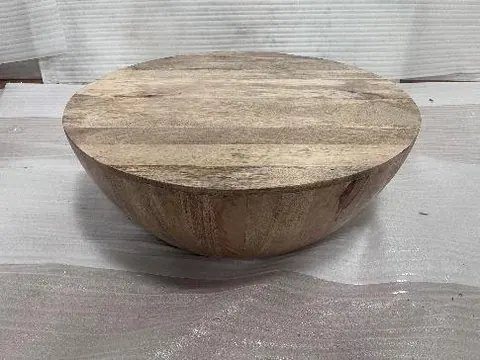
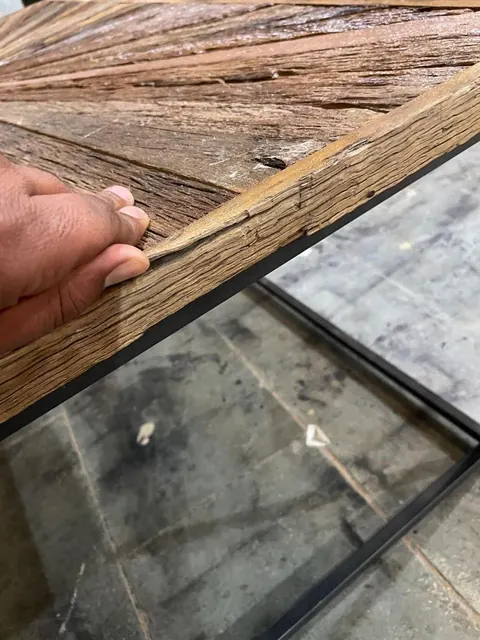
What we check on wooden coffee tables
| Check | How it is checked | What fails |
|---|---|---|
| Top flatness | Straightedge across the width at both ends and the middle, and along both diagonals | Cup or twist beyond the agreed limit; glue lines stepped |
| Finish cure | Fingernail pressure on a hidden area; smell; wrap marks on packed tops | Soft finish that takes a print, strong solvent smell, marks from packing film |
| Finish resistance | Water drop left on an agreed hidden spot or a finished offcut for an agreed time | White ring, raised grain or dull patch after wiping |
| Storage lid | Lid opened, released at several angles; hinge screws and stay checked | Lid slams shut, stay missing, hinge screws into end grain pulling out |
| Drawers | Each drawer opened both ways if it runs through; stops tried | No stop, drawer drops when fully open, front misaligned with the apron |
| Knock-down legs | Assembly trial with only the supplied hardware; leg pushed sideways after tightening | Leg wobbles, hanger bolt loose in the leg, plate screws too short or through the top |
| Lower shelf | Shelf pressed and loaded by hand; slat spacing and fixings checked | Shelf rattles, sags or has slats loose at one end |
| Finish on edges and underside | Underside and inside of apron checked for a sealing coat | Raw underside on a lacquered top, which makes it cup faster |
An unsealed underside is a quiet cause of cupping. When one face is lacquered and the other bare, the bare face takes up and loses moisture faster, and the top bends.
Common wooden coffee table defects and how they are classed
| Defect | Class |
|---|---|
| Storage lid that drops shut with no stay | Critical |
| Screw tip through the top from a leg plate | Major |
| Top cupped beyond the agreed limit | Major |
| Leg wobbles after assembly with the supplied hardware | Major |
| Soft, uncured finish; packing marks in the lacquer | Major |
| Water ring on the agreed spot test | Major |
| Drawer with no stop | Major |
| Stepped glue line on the top | Minor |
| Raw underside | Minor (major if specified) |
Market rules that apply
- Wood origin. Each species goes on the US Lacey Act declaration, and wooden furniture is in scope of the EU EUDR.
- Composite parts. An MDF shelf, plywood drawer bottom or veneered top makes the table a regulated finished good under TSCA Title VI in the US. In the EU, the REACH formaldehyde emission limit for furniture has applied since 6 August 2026.
- Finishes. REACH in the EU and Prop 65 in California cover lacquers and stains; the US lead-in-paint limit applies to painted finishes.
- Buyer standards. EU buyers often specify EN 12521 for domestic tables. For finish performance, EN 12720 (cold liquids), EN 12721 (wet heat) and EN 12722 (dry heat) are lab test methods; the liquids, times and pass levels come from your specification. See EN furniture testing.
The water-drop check at the factory is a screen, not a substitute for those tests. We can pull and seal finished panels for a lab.
Packing, transit and loading risks
- Weight on a flat top. A solid top is heavy for its carton. In our Sample 01 report, two 90 × 90 cm solid wood coffee table styles weighed 17.65 kg and 16.10 kg each. Cartons need corner blocks that carry that weight in a drop.
- Face protection. Foam or paper between the top and any film, so fresh lacquer is not marked.
- Legs off. Knock-down legs wrapped separately, so they do not dent the top. Hardware bag fixed inside the carton.
- Lids and drawers. Lids taped shut through a protective layer; drawers wedged so they do not slide.
What to put in your purchase order
- Maximum cup and twist across the top, in millimetres.
- Finish type and a sealing coat on the underside and inside the apron.
- Finish resistance: the test standard and level, or at least a water-drop spot test at inspection.
- Lid stay or soft-close hinge on any lift-up lid.
- Drawer stops, and how through-drawers are stopped on both sides.
- Knock-down leg hardware: bolt size, plate type and screw length for the top thickness.
- Which parts may be MDF or plywood, with TSCA Title VI labels for the US.
Related tables: marble-top coffee tables, metal coffee tables and wooden TV units for a matching set. To check your order, book an inspection.