How stone top furniture is made in India
Rajasthan is a major marble producer. The Indian Bureau of Mines lists the Makrana–Kishangarh belt and the Udaipur–Rajsamand–Chittorgarh region among its main marble areas. Makrana in Nagaur district is known for pure white crystalline marble, and Kishangarh in Ajmer district has a large number of gangsaw units that cut blocks into slabs.
From the slab, a stone unit or the furniture factory cuts the top to size on bridge saws or by hand, profiles and polishes the edges, and grinds and polishes the face. Natural voids and fine cracks are often filled with coloured resin or epoxy. Brittle stones may get a fibreglass mesh glued to the underside. The top is then sealed, and joined to a wood or metal base by adhesive, brackets or locating pins, or simply set on top.
Stone is natural, so no two tops are alike. Colour and veining vary from block to block and even across one slab. A good order therefore starts with an agreed range of acceptable tops, not a single photo.
From our inspections
Real photos from our published sample reports, anonymised. Click a source to read the full report.
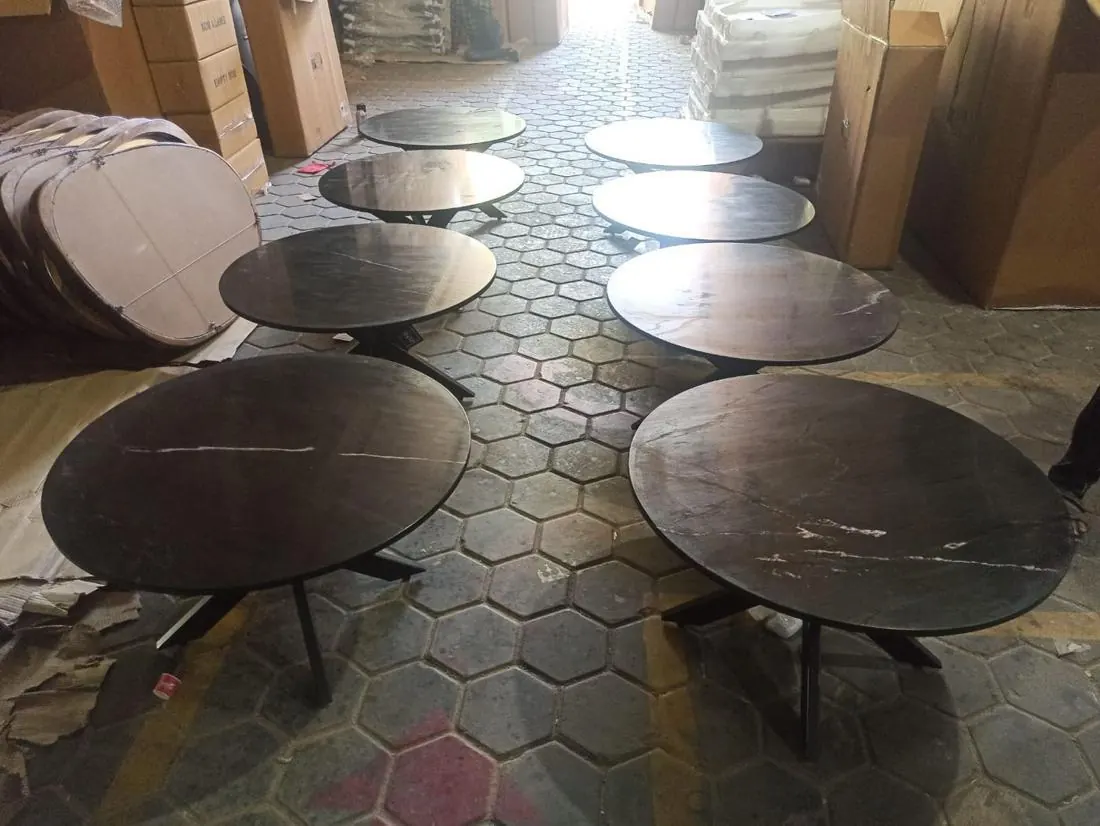
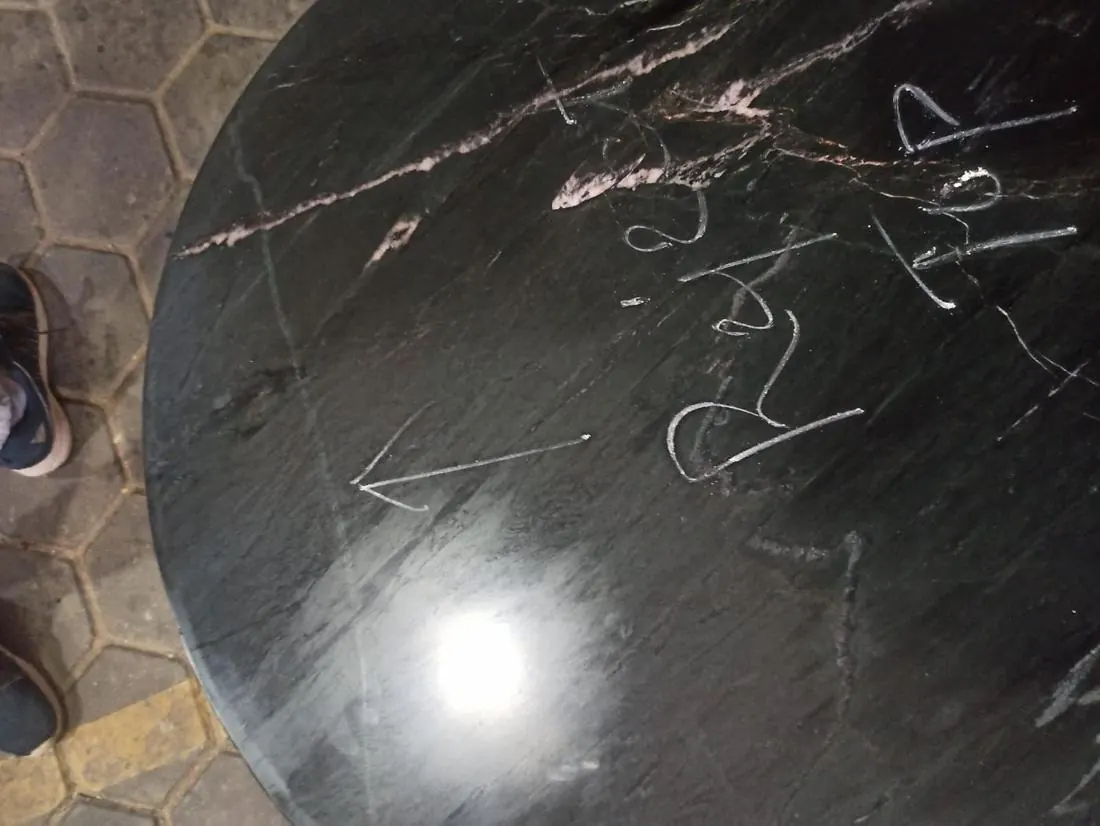
What we check on stone tops
| Check | How it is checked | What fails |
|---|---|---|
| Cracks | Raking light across the face and edges; a damp cloth wiped over the surface makes hairline cracks show; underside checked | Any crack through the top; hairline cracks running from an edge or a fill |
| Chips and edges | Fingertip and visual check along every edge and corner; edge profile against the drawing | Chips, flaking, uneven profile, sharp arris |
| Fills | Look for resin or epoxy areas; compare colour with the stone | Fills larger or more visible than agreed, sunken or cracked fills, fills hiding a structural crack |
| Colour and veining | Against the approved range in daylight; sets laid out together; book-matched tops checked for alignment | Tops outside the range, mixed backgrounds in one set, veining that does not continue across a joint |
| Polish and flatness | Visual gloss check; straightedge across the top | Dull or patchy polish, swirl marks, dips, rocking on a flat surface |
| Thickness and size | Calliper and tape at several points | Thinner than ordered, out-of-square tops, holes or cut-outs off-position |
| Sealing | A few drops of water on an agreed hidden area; see whether it darkens the stone quickly | Fast absorption on a top sold as sealed |
| Fixing and stability | Top fitted to base; pins, brackets and adhesive checked; push test at the edge | Top slides or lifts off, overhang that tips the table, base that rocks |
| Weight | Product and carton weighed | Far off the specification, a sign of the wrong thickness or stone |
Stain resistance, flexural strength and slip are lab tests. We can pull samples for a lab if your buyer needs them.
Common marble and stone top furniture defects and how they are classed
| Defect | Typical class | Why |
|---|---|---|
| Top not fixed and able to slide or tip off its base | Critical | A falling stone top can crush a child or a foot |
| Crack through or into the top | Major | It will open further in transit and use |
| Chipped edge or corner | Major | Visible and sharp |
| Fill colour or size beyond the agreed limit | Major | Looks like a repair |
| Top outside the agreed colour range | Major | Does not match the set |
| Small polish marks on the underside or edges | Minor | Cosmetic |
In our Sample 04 report from Jodhpur, two black marble tables had cracked tops, recorded as major and marked for replacement. Two marble dining table styles in the same order passed. With cracks in wood also found elsewhere, the order of 661 pieces was Not cleared: 8 major defects against a reject number of 6.
Market rules that apply
- Safety and stability. Under the EU GPSR, a heavy top that can slide or tip is a safety issue. Assembly instructions and warnings, such as fixing the top and two-person lifting, should be in the box. Buyers often test tables to EN 12521; see EN furniture tests.
- Bases. A wooden base brings in the Lacey Act and EUDR. A painted or powder-coated metal base falls under the US 90 ppm lead-in-paint limit (16 CFR 1303); see CPSC and CPSIA rules.
- Sealers and resins. REACH applies to fills and sealers; check whether a Prop 65 warning is needed in California.
- Crates. Solid-wood crates and pallets need the ISPM 15 mark.
Packing, transit and loading risks
Packing decides whether a stone top survives the trip. The main points:
- Top on edge, not flat. Stone is far stronger on its edge. Tops travel best standing upright in a wooden crate or frame, cushioned on all sides, and never with weight on their face.
- Top and base apart. The top should be packed separately from the base, or fully blocked, so the base cannot knock into it.
- Corners and edges. Rigid corner guards and full edge protection, not just foam sheet.
- Weight and handling. Check gross weight against the specification and that the crate has forklift access and handling marks.
- Loading. Heavy crates go on the floor, upright and lashed so they cannot move. Loading supervision checks this.
What to put in your purchase order
- Stone type and name, finish (polished, honed, leathered), thickness and edge profile.
- An approved range of tops for colour and veining, photographed or sealed as reference pieces.
- Rules for fills: allowed or not, maximum size, colour match.
- Mesh backing allowed or not; sealer type.
- How the top fixes to the base, and warnings to include.
- Crating method, maximum gross weight and ISPM 15 crates.
See also marble-top coffee tables and dining tables. To have stone tops checked before they are crated, book an inspection.