Why console tables need their own checks
A console table is a dining-height table squeezed into the depth of a shelf. That shape is the whole risk. With a narrow footprint and a high top, a small push at the front edge creates a large turning force. A drawer pulled open, a child hanging on the top, or a heavy lamp near the front can be enough to tip it.
Indian consoles add their own variables. A solid sheesham top with a carved apron is heavy at the top and light at the feet. An iron base with thin splayed legs may flex sideways. Marble tops raise the weight further. The same design can behave differently from one batch to the next if the top thickness or timber changes.
Consoles also stand in hallways and behind sofas, so they are seen from the back and sides. Buyers who sell a "floating" console need the back finished to the same standard as the front.
From our inspections
Real photos from our published sample reports, anonymised. Click a source to read the full report.
What we check on console tables
| Check | How it is checked | What fails |
|---|---|---|
| Depth and height | Measure against the PO; depth matters most for stability | Shallower or taller than ordered |
| Front tip check | With drawers open, apply the hand load the buyer sets at the front edge on a level floor | Rear feet lift; table tips forward |
| Side sway | Push the top sideways and watch the legs and joints | Visible racking, loose joints, flexing iron legs |
| Wall-anchor kit | Open the carton; check bracket, screws, instructions and pre-drilled holes in the back rail | Kit missing, holes not drilled, instructions silent on anchoring |
| Top flatness | Straightedge along the full length and across the width | Sag or bow beyond the agreed limit; twist |
| Drawers | Open each to its stop; check runners and gaps | No stop, drawer drops out, sticks, uneven gaps |
| All-round finish | Inspect back, sides and underside if the PO says the back is visible | Unfinished or rough back on a floating console |
The tip check at the factory is a screening check, not a lab test. It shows whether a design or a batch is likely to have a problem before goods are shipped.
Common console table defects
| Defect | Typical class | Notes |
|---|---|---|
| Tips forward under the agreed front load | Critical | Tip-over can injure a child; fails the lot on its own |
| Anchor kit or toppling label missing where required | Critical or major, as the buyer sets | A legal gap for Australia |
| Top bowed along the span; crack in a solid top | Major | Long tops in solid wood move with humidity |
| Uneven or flexing iron frame | Major | The table rocks and racks |
| Drawer without a stop | Major | Drawer falls out and shifts weight forward |
| Scratch on an iron frame; minor finish marks | Minor | Cosmetic |
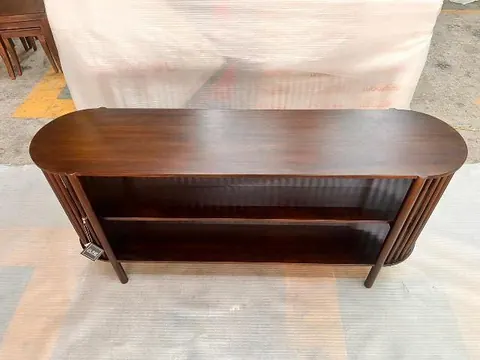
Our real reports include two console tables. A Jaipur console in Sample 02 had no finding. A wood and iron console in Sample 04 had a minor scratch on the iron frame.
Market rules for console tables
- Australia. The Consumer Goods (Toppling Furniture) Information Standard 2024 has applied since May 2025. Hall tables 686 mm or taller fall in its Category 3, with display cabinets, sideboards and buffets. Each needs a permanent warning label with the anchoring messages for that category, and the same warnings in the instructions and listings. See importing into Australia.
- EU. EN 12521:2023 sets safety, strength and durability requirements for domestic tables and has an informative table-top deflection test in Annex B, useful for long console tops. The legal duty is the general safety requirement of the GPSR.
- US. The STURDY Act rule covers clothing storage units, not console tables. US buyers still often supply an anchor kit as good practice. Wood needs a Lacey Act declaration, and composite panels need TSCA Title VI labels.
Packing and loading
A console top is long and narrow, so it bends and its ends take the knocks. We check that the corners and both ends have solid protectors and that the top cannot slide inside the carton. Where the legs or base ship detached, the bolts and anchor kit should be in a sealed bag fixed inside the carton, not loose. In the container, long cartons should stand on edge or lie flat on a full layer, never bridging a gap between two lower cartons.
What to put in your console table PO
- Depth, height and length with tolerances, and the maximum top thickness that keeps the tested stability.
- A front-load stability requirement with drawers open, and who tests it.
- Anchor kit contents, pre-drilled holes and the warning label artwork for each market.
- Whether the back is a visible face.
- Top flatness limit along the span.
For a range of consoles, sideboards and TV units from one factory, one visit can cover them all; send the PO and we confirm the man-days.