How framed mirrors are made in India
Most framed mirrors from India are two products put together. The frame is carved, turned or welded in the factory: mango or sheesham wood in Jaipur, deep-carved wood in Saharanpur, iron, bone inlay or metal-clad frames elsewhere. The mirror glass is bought from a glass trader already silvered, cut to shape, then fixed into the frame rebate with glazing points, clips or silicone and closed with a backing board.
So the factory controls the frame, but not the glass. Mirror glass is a coated product: a thin silver layer protected by paint on the back. If the edge is cut roughly or left unsealed, moisture creeps under the paint and the silver darkens from the edge inward. That "black edge" may not show at the factory and then appear months later in a bathroom or a humid hallway.
From our inspections
Real photos from our published sample reports, anonymised. Click a source to read the full report.
What we check on mirrors
| Check | How it is checked | What fails |
|---|---|---|
| Glass thickness | Calliper at an exposed edge or through the back opening | Thinner than the PO, for example 3 mm where 4 mm was ordered |
| Silvering | View the face at an angle against a plain light background; look at all edges | Black or brown edges, spots, scratches through the silver, hazy patches |
| Distortion | Look at a straight line reflected across the mirror from a distance | Wavy or bent reflection |
| Safety backing film | Check the back for film coverage, adhesion at the corners and any label | No film where ordered; film lifting or short of the edges |
| Glass fixing | Press gently on the glass; check clips, points or silicone from the back | Glass rattles or moves in the rebate |
| Frame corners and joints | Look along each mitre and joint; flex the frame lightly | Cracks, open mitres, filler showing |
| Hanging hardware | Check type, screws and fixing into solid timber; hang the mirror with the buyer's test load | D-rings screwed into board edges, wire that slips, bracket bends or pulls out |
Common mirror defects and classes
| Defect | Typical class | Notes |
|---|---|---|
| Cracked glass; hanging fixing pulls out under the test load | Critical | The mirror can fall and break |
| No backing film on a mirror ordered with film | Major or critical, as the buyer sets | Fragments are not held if it breaks |
| Crack in a frame corner | Major | Weakens the frame that carries the glass |
| Black edge or silver spots in the viewing area | Major | Visible and spreads with moisture |
| Glass thinner than ordered | Major | Heavier glass may have been designed into the hanging load |
| Loose glass that rattles | Major | Chips at the edge in transit |
| Small finish faults on the frame | Minor | Cosmetic |
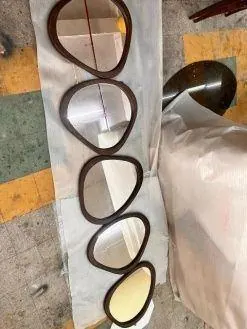
Both appear in our real reports. In Sample 02, three styles of organic-shape wall mirrors, 200 pieces in all, had no findings. In Sample 04, a wooden mirror frame had a crack in the frame corner, recorded as major.
Glass rules by market
- EU. EN 1036-1 sets minimum quality limits for optical, visual and edge faults and durability tests for mirrors from silvered float glass, 2 to 10 mm thick, for internal use in buildings. It excludes toughened and laminated glass and humid settings such as saunas and pools. EN 14072, the test-method standard for glass in furniture, does not cover glass supported over its whole area, including wall-fixed mirrors. Impact classification of the glass itself is in EN 12600. The legal duty is the GPSR general safety requirement.
- UK. BS 7449, which covered glass in cabinets, shelving and wall-hung or free-standing mirrors, was withdrawn on 31 May 2006. UK buyers now rely on their own specification under general product safety law. See UK import compliance.
- US. The federal safety glazing standard, 16 CFR 1201, lists storm doors, doors, bath and shower enclosures and patio doors. It does not list furniture or wall mirrors, so glass type and backing come from your specification. Frame finishes fall under Prop 65 and lead-in-paint limits.
- Wood frames. Lacey Act and EUDR records apply as for other wooden furniture.
Packing mirrors for export
Mirrors break at the corners and edges, not in the middle. We check corner protectors on all four corners, a rigid board over the face, and that the mirror cannot slide inside the carton. Cartons should carry "glass" and "this way up" marks, and should be loaded standing on edge, never lying flat under heavier cartons. Hanging hardware is safer packed in a sealed bag than left fitted, where it can press into the glass. A carton drop test followed by unpacking shows whether the packing works.
What to put in your mirror PO
- Glass thickness, edge finish (polished, bevelled) and edge sealing.
- Safety backing film: yes or no, and type.
- Silvering acceptance: no visible defect at a stated viewing distance.
- Hanging hardware type and the test load, for example a multiple of the mirror's weight, as you decide.
- Frame joints and the fixing method for the glass.
Mirror orders mix well with cabinets and console tables from the same factory; book one visit for the whole range.
Sources
- SIS: SS-EN 1036-1:2007, Mirrors from silver-coated float glass for internal use (abstract)
- SIS: SS-EN 14072, Glass in furniture, test methods (abstract)
- BSI: BS 7449:1991, glass in furniture other than tables (withdrawn)
- 16 CFR 1201.1, scope of the US safety glazing standard
- Regulation (EU) 2023/988 on general product safety (EUR-Lex)