What makes a metal and wood dining table different
Top flatness, cracks, filler and extension slides are on the dining tables page. Weld quality, coating thickness and rust are on the metal furniture page. This page covers the joint between the two materials, which is where most problems with this type of table start.
Solid wood moves across its grain as humidity changes; steel does not. A top 90 to 100 cm wide can change width by several millimetres between a monsoon workshop and a heated dining room. If it is screwed tight to a rigid steel frame at both edges, something gives: the top cracks, the screws pull out, or the frame bends.
The two halves are also usually made apart. Tops come from the wood shop and bases from a fabricator or job shop, often coated by a third. They meet for the first time at final assembly or, on knock-down tables, at the customer's home. Common bases are four-leg tube frames, U or trapezium legs in flat bar, X or trestle legs, and single pedestals with a plate under the top.
From our inspections
Real photos from our published sample reports, anonymised. Click a source to read the full report.
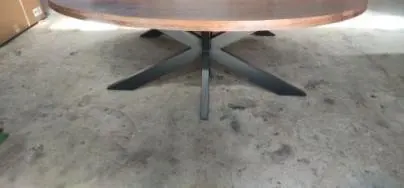
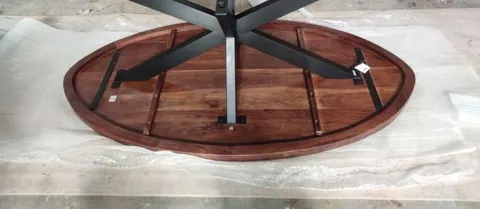
What we check on metal and wood dining tables
| Check | How it is checked | What fails |
|---|---|---|
| Movement allowance | Fixing plates on the base checked for slotted holes running across the grain of the top | Round holes at both edges of a wide top, top glued to the frame |
| Screw length and inserts | Screw length compared with plate thickness and top thickness; threaded inserts tried with the bolt | Screws long enough to reach the top face, inserts that spin or pull out |
| Base flat to the top | Base placed upside down on the top; gaps at each fixing plate measured | Base out of plane, so the top is pulled down at one corner |
| Levelling on the floor | Assembled table on a flat floor; glides wound in, then adjusted | Rocks with glides wound in, glide thread blocked |
| Contact faces | Pads or felt between steel and wood checked; underside of top checked for marks | Bare steel on wood, black iron stain, coating chips on the plate |
| Finish pairing | Assembled table compared with the approved wood-and-coating sample | Wood shade or coating colour out of the approved pair |
| Pedestal stability | Downward hand load at the edge of the overhang | Table lifts on the opposite side |
Common metal and wood dining table defects and how they are classed
| Defect | Class |
|---|---|
| Pedestal table tips with load at the edge | Critical |
| Screw tip breaks through or bulges the top face | Major |
| Wide top fixed through round holes at both edges | Major |
| Insert spins or pulls out of the top | Major |
| Base out of plane, table rocks | Major |
| Black iron stain on the wood | Major |
| Coating colour or wood shade outside the approved pair | Major |
| Scratch on the base, visible at normal distance | Minor |
| Felt pad missing at one fixing point | Minor |
Two of our real reports include tables of this type. In Sample 01 (Jodhpur, November 2022), round wood and metal tables shipped as separate tops and bases, both measured 120 × 120 × 76 cm against the order with no deviation, and passed. In Sample 04 (Jodhpur, January 2023), a large wood and iron table had an uneven iron frame with scratches, recorded as major.
Market rules that apply
- Two materials, two sets of rules. The top brings the timber rules: Lacey Act species declaration for the US and EUDR due diligence for the EU, where wooden tables are in scope. The base brings coating rules: 16 CFR 1303 lead in paint in the US and REACH in the EU.
- Customs code. Whether a table is classed as wooden or metal furniture affects which EUDR and tariff rules apply. Agree the code with your broker; it should match how the factory describes the goods.
- Strength and stability. EU buyers often ask for EN 12521:2023 for domestic tables. See EN furniture testing.
- California. Coatings and wood finishes may need a Prop 65 warning.
Packing, transit and loading risks
- Tops and bases in separate cartons. Count both and check they match in number and style. Label each carton so a top and its base reach the customer together.
- Base against top. If they share a carton, a steel base must never touch the wood face. A rigid board between them prevents dents and coating transfer.
- Damp steel. A base packed damp can leave rust or iron stains on a wood top in the same carton. Both should be dry when packed.
- Hardware. Bolts, inserts and felt pads go in one labelled bag fixed inside the top's carton.
What to put in your purchase order
- Fixing design: slotted holes across the grain, number of fixings, and which point is fixed.
- Screw length and type, or insert type and bolt size, with the top thickness.
- Flatness tolerance for the base fixing plates.
- Felt or rubber pads at every steel-to-wood contact.
- An approved pair: wood finish sample and coating colour chip, signed off together.
- Levelling glides on every leg.
- For pedestals, a stability check at the edge of the overhang.
For an all-timber table, see wooden dining tables. For another steel and wood pairing, see metal TV units.