How dining tables are made for export
A dining table is two products: a top and a base. Indian factories often make them in different sections, or buy one in, and ship them in separate cartons to be joined by the customer with bolts or brackets. Solid tops are edge-glued from several boards; live-edge and slab tops may be one or two wide pieces, with cracks and knots stabilised with epoxy. Marble tops come from stone units and are fitted to a wood or iron base.
The top is the risk. It is the largest single piece of wood in most orders, it is the surface the customer looks at every day, and it reacts most to the change from humid workshop to heated home. Extension tables add a mechanism that must line up to the millimetre.
From our inspections
Real photos from our published sample reports, anonymised. Click a source to read the full report.
What we check on a dining table
| Check | How it is checked | What fails |
|---|---|---|
| Top flatness | Straightedge along, across and diagonally; gap measured with feeler gauges | Cupping or bowing beyond the tolerance in your specification |
| Twist | Top laid on a flat surface or checked with winding sticks; corners measured | One corner lifting, a top that rocks on the base |
| Wobble | Assembled table on a flat floor; gap under the lifted leg measured; table pushed at the corners | Rocking, racking at the leg joints, loose bolts |
| Glue lines, cracks, filler | Top inspected in raking light, top and underside, end grain first | Open glue lines, end checks, filler or epoxy visible where the spec does not allow it |
| Extension mechanism | Leaves fitted and removed several times; slides run; locks and alignment pins checked | Steps between leaf and top, gaps, slides that stick, leaves in a different colour |
| Seating clearance | Height from floor to underside of apron; space between legs measured | Clearance less than specified; chairs that do not fit under |
| Top-to-base fixing | Base fitted to top with supplied hardware; fixing points checked | Holes that do not align, screws into end grain, no allowance for wood movement |
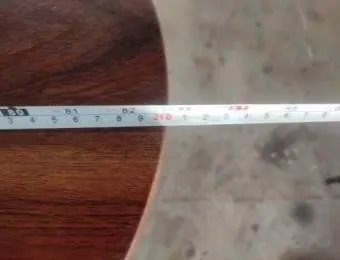
Height is measured on every sampled table. Moisture is measured on the top and on thick legs, where wet wood hides longest.
Common dining table defects
| Defect | Usual class | Why |
|---|---|---|
| Table collapses or a leg joint fails under hand load; glass top with sharp edges | Critical | Risk of injury |
| End crack or split in the top | Major | Grows after delivery |
| Visible epoxy or filler not allowed by the spec | Major | Seen at once by the customer |
| Wobble on a flat floor | Major | Felt every time the table is used |
| Extension leaf does not align or lock | Major | Function failure |
| Grinding or sanding marks, small finish faults | Minor | Cosmetic |
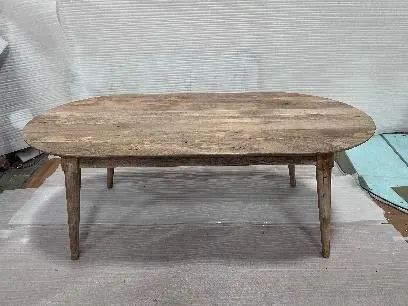
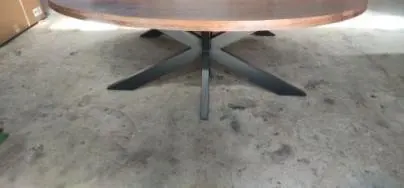
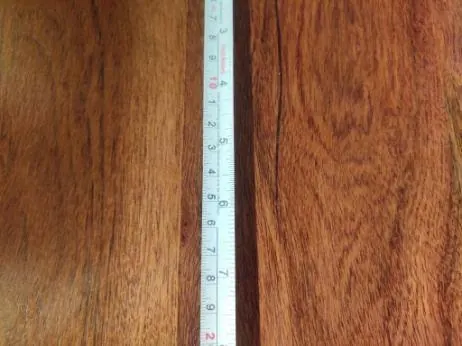
Our Sample 03 shows how this works on real goods. In Jaipur, twelve pieces of an oval dining table order were checked: six tops and six cross-leg bases. The bases passed, but two tops were rejected, one with visible araldite (epoxy) filling and one with an end crack. Against a reject number of 1, the lot was Not cleared, and both tops had to be replaced or remade. In Sample 01 a solid wood dining table had grinding marks on the surface, a minor defect, and measured 75.3 cm high against 76 cm ordered.
Rules and standards for dining tables
| Market | Rule or standard | What it means here |
|---|---|---|
| United States | Lacey Act, TSCA Title VI, 16 CFR 1303, Prop 65 | Species and harvest country declared; composite cores labelled; paint at or below 90 ppm lead; warnings where needed |
| European Union | EUDR, GPSR, REACH | Timber due diligence, general safety and traceability, chemicals in finishes and the furniture formaldehyde limit |
| EU buyers' test standard | EN 12521:2023 (domestic tables, including glass tables) | Strength, durability, stability and finger entrapment, tested in a lab; see EN furniture testing |
| Contract and hospitality | ANSI/BIFMA X5.5-2021 (US), EN 15372 (EU, non-domestic tables) | Tables for offices, restaurants and other commercial use are tested to these instead |
An inspection checks construction, labels and documents against the tested sample. Load and durability tests need an accredited lab.
Packing and transit risks
- Tops. Corners and edges take the hits. Ask for full edge protection and a rigid board over the face, so carton pressure does not mark the finish.
- Marble and glass. These need a separate crate or a reinforced carton with the top on edge, and a fragile mark. A cracked marble top was a major finding in our Sample 04.
- Matched sets. When top and base ship in separate cartons, both must be in the container in equal numbers. In Sample 03 the inspector counted 20 tops and 20 bases separately.
- Weight. Heavy tops crush cartons stacked below them. The inspector weighs cartons and checks the stacking mark.
What to put in your purchase order
- Flatness and twist tolerance for the top, in millimetres over the length.
- Whether epoxy, filler and visible knots are allowed, and where. Photos of acceptable and unacceptable examples help.
- Height, apron height and leg spacing, with tolerances, and the chairs the table must seat.
- Extension type, number of leaves, and how leaves are stored and finished to match.
- Top-to-base hardware and fixing method.
- Moisture target for the destination climate, and a sealed finish sample.
For a new design, a pre-production inspection checks the timber and glued-up tops before finishing hides the joints.