Sheesham: the wood and how factories buy it
Sheesham is the trade name for Dalbergia sissoo, a member of the rosewood genus. Like other commercial Dalbergia, it has a dark heartwood, here golden to deep brown, and a pale, yellowish sapwood with a sharp boundary between the two. That contrast drives most of the quality questions on a sheesham order.
Do not confuse it with Dalbergia latifolia, which is also sold as Indian rosewood. The two are different species and must be declared separately.
Most sheesham used in Indian furniture is grown on farms, along canals and roads, and in plantations, then sold through timber merchants, depots and auctions. Lots from many trees are mixed, so one top can combine boards of different colour. In Saharanpur, a Down To Earth report notes that sheesham once came from the area and the nearby Shivalik hills, and is now brought in from other districts. Saharanpur's carved woodwork is a registered Geographical Indication, and the Development Commissioner (Handicrafts) lists sheesham and teak as its preferred woods.
Factories saw logs to planks, air-dry them, and kiln-dry where they have access to a kiln. Sheesham is usually finished in a natural, honey or walnut tone with lacquer, PU or wax. A dark stain is often used to blend sapwood into heartwood, and that is where colour problems start.
From our inspections
Real photos from our published sample reports, anonymised. Click a source to read the full report.
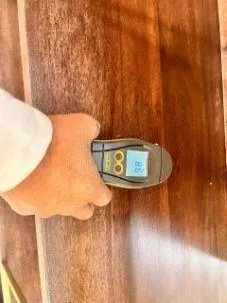
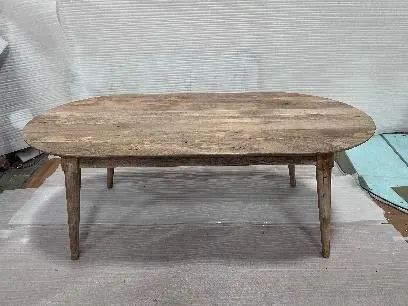
What we check on sheesham furniture
| Check | How it is checked | What fails |
|---|---|---|
| Sapwood on visible faces | Each top, front and side checked against the agreed sapwood allowance or photo standard | Pale streaks on show faces beyond the allowance, or sapwood stained dark that reads blotchy |
| Colour within a piece | Edge-glued tops and door panels checked board by board in daylight | One board visibly lighter or redder than its neighbours |
| Colour across a set | Pieces of one style lined up side by side against the approved sample | Pieces of the same style outside the agreed colour range |
| Insect damage | Sapwood edges, undersides and backs checked for pinholes and fine powder (frass) | Any borer holes; live activity is reported for an immediate decision |
| Moisture content | Pin meter set for a dense hardwood group, readings on thick parts and tops | Readings above the buyer's limit (default 11%) |
| Carving and fretwork | Carved panels, legs and aprons checked for chips, breaks and glued-on repairs | Broken or re-glued carving on visible parts |
| Species | Grain, colour and smell compared with the order; doubtful parts sampled for lab identification | Another wood substituted in hidden parts or whole pieces |
Common sheesham defects
| Defect | Typical class | Note |
|---|---|---|
| Borer holes with fresh frass | Critical or major, per the buyer's list | Live insects can spread in the container and at the buyer's warehouse |
| Sapwood on a top or front beyond the allowance | Major | Sapwood is usually the part borers attack, so it is also a durability point |
| Colour mismatch between pieces of one style | Major | Shows on the shop floor when pieces stand together |
| Glue-line opening in an edge-glued top | Major | Often follows wet timber or a dense board glued to a lighter one |
| Chipped or broken carving | Major or minor | Depends on size and position; common in Saharanpur-style carved pieces |
| Single board slightly off-tone inside a top | Minor | Natural variation, unless your specification is strict |
| Stain build-up in carving or corners | Minor | Hand finishing leaves dark pools in recesses |
Natural colour variation is part of sheesham. The way to avoid a dispute is to agree a range, not a single colour, before production: a light and a dark limit sample, sealed and kept at the factory.
CITES, Lacey and EUDR for sheesham
- CITES. All Dalbergia species, including sheesham, were placed in CITES Appendix II from 2017. At CoP19 in November 2022 the proposal by India and Nepal to remove D. sissoo was rejected, and the parties agreed instead to amend annotation #15 to cover finished furniture and handicrafts of D. sissoo first exported from India and Nepal. Read the current annotation in the CITES Appendices and confirm with India's CITES authorities whether your product needs a permit before you ship.
- United States, Lacey Act. Declare Dalbergia sissoo and India as the country of harvest, plus every other wood in the piece, including plywood backs and drawer bottoms.
- European Union, EUDR. Farm and roadside trees come from many small plots, each of which needs a geolocation. Start collecting records from the timber supplier early.
- Finishes. Stains and lacquers fall under EU REACH and Proposition 65 for California.
- Composite parts. A plywood back or MDF drawer bottom brings in TSCA Title VI for the US.
An inspection can check that the wood in the goods matches the order and that the factory holds purchase records for the quantity shipped. It cannot certify CITES or EUDR compliance.
Packing, transit and loading
Sheesham is a dense, heavy wood, so solid sheesham sideboards and dining tables put real weight on carton corners. We weigh cartons, run drop tests on heavy styles and check that carved parts are padded so nothing presses on them. If borer holes were found, we recommend the lot is treated and rechecked before packing, because sealed cartons hide activity. Pallets and crates need the ISPM 15 mark.
What to put in your sheesham purchase order
- Species by component, with Dalbergia sissoo named, and any other wood allowed in hidden parts.
- Sapwood allowance for show faces and hidden faces, with photos.
- Colour range: light and dark limit samples, sealed.
- Moisture target and limit for your market; our default limit is 11%.
- Insect treatment: what the timber merchant or factory applies, and the records you need.
- Timber purchase invoices and plot or supplier records for Lacey and EUDR.
Book an inspection to check these points at the factory in Jodhpur, Saharanpur or anywhere else in India.
Sources
- CITES CoP19 Prop. 47: deletion of Dalbergia sissoo from Appendix II (India, Nepal)
- CITES CoP19 Com. I Rec. 7 (Rev. 1): amendment to annotation #15
- Earth Negotiations Bulletin, CITES CoP19 daily report, 17 Nov 2022
- Down To Earth: CITES relaxes restrictions on export of Indian shisham products (24 Nov 2022)
- Down To Earth: The wood famine (Saharanpur sheesham supply)
- The Wood Database: Dalbergia genus (heartwood, sapwood, 2017 CITES listing)
- Office of the Development Commissioner (Handicrafts): Saharanpur Wood Craft