How sideboards are built, and where they go wrong
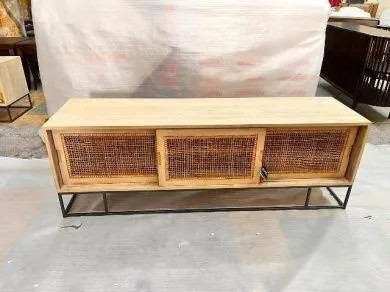
A sideboard is a long cabinet (the woven-panel sideboard in our Sample 01 measured 170 cm) with a row of doors, a bank of drawers, or both. Indian factories usually build the carcass in solid wood with a framed or boarded back, fit wooden or metal drawer runners, and hang the doors last. The top is either glued-up solid boards or a veneered panel. Many export ranges add woven, cane or slatted door panels, or an iron base.
The length is what makes sideboards difficult. A small twist in the carcass or an uneven floor in the factory shows up as doors that meet at an angle. A long solid top shrinks and swells across its width with the seasons, so if it is screwed down rigidly it cracks. Drawers in a long cabinet are often hand-fitted one by one, so their fit varies across the lot.
From our inspections
Real photos from our published sample reports, anonymised. Click a source to read the full report.
What we check on a sideboard
| Check | How it is checked | What fails |
|---|---|---|
| Level and twist | Unit placed on a flat surface; spirit level on the top; diagonals of the carcass measured | Rocking on a flat floor, diagonals out of square, a top that is not level front to back |
| Door alignment and gaps | Gap gauge between doors and around the frame; doors closed in sequence | Tapered or uneven gaps, doors at different heights, doors that do not close flush |
| Sliding doors | Each door run end to end in its track | Doors that jam, jump the track or leave a gap when closed |
| Drawer runners | Every drawer opened to its stop and closed, empty and with a light load | Drawers that bind, drop when open, have no stop or pull out entirely |
| Shelves | Shelf sits flat on all supports; buyer-specified load placed; deflection measured | Rocking shelves, loose shelf pins, visible bowing under load |
| Feet and adjusters | Feet checked for fixing; levelling glides turned | Loose feet, seized or missing adjusters |
| Top fixing | Underside checked for slotted fixings or buttons that let a solid top move | Solid top screwed rigidly across its width |
The inspector also does the core checks: dimensions, moisture content, finish against the approved sample, hardware, labels and packing.
Common sideboard defects
| Defect | Usual class | Why |
|---|---|---|
| Unit tips forward with drawers or doors open | Critical | Risk of injury |
| Protruding nails, staples or sharp metal edges in reach | Critical or major, by position | Risk of cuts; agree the class in your plan |
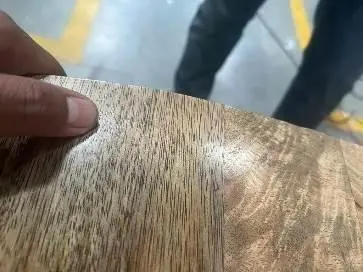
| Crack in top or panel | Major | Grows in heated rooms |
| Shelf does not sit level or bows | Major | Function and appearance |
| Drawer binds or has no stop | Major | Function; a falling drawer can injure |
| Uneven door gaps, visible nail heads, small finish marks | Minor | Cosmetic, within buyer's limits |
Our real reports show several of these. In Sample 01 a woven-panel sideboard had visible nails, recorded as minor. In Sample 04 a wooden cabinet had a crack and a shelf that did not sit level, recorded as major. In Sample 05 a five-drawer cabinet tipped forward with all drawers open: a critical defect that left the lot Not cleared on its own. That cabinet was not a sideboard, but a drawer-heavy buffet behaves the same way.
Rules that apply to sideboards and buffets
| Market | Rule | What it means here |
|---|---|---|
| Australia | Consumer Goods (Toppling Furniture) Information Standard 2024, since 4 May 2025 | Sideboards and buffets 686 mm or taller need a permanent warning label and safety information. See importing into Australia |
| United States | STURDY Act | Dining room furniture is excluded, but a "sideboard" sold as bedroom storage may be a clothing storage unit. Check the use you market it for |
| United States | TSCA Title VI, Lacey Act, Prop 65 | Composite backs and shelves labelled; timber declared; warnings for listed chemicals |
| European Union | GPSR, REACH, EUDR | General safety and traceability, furniture formaldehyde limit, timber due diligence |
For strength and stability, EU buyers often specify EN 14749 for domestic storage units; see EN furniture testing. Stability and strength tests need an accredited lab; we can pull and seal samples.
Packing and transit risks
A sideboard is heavy and long, and the damage pattern is predictable: crushed corners, racked carcasses and doors knocked out of line.
- Drawers and doors must be blocked or taped so they cannot slide or swing in the carton.
- Loose shelves should be wrapped and fixed, not left to slide against the doors.
- A carcass with only a thin back panel racks when the carton is tipped; ask for internal bracing or a stiffer carton for long units.
- Iron bases and removable feet go in a separate fixed pack.
After the carton drop test the inspector re-checks door gaps and drawer runs, because a carcass that has racked shows it there first.
What to put in your purchase order
- Door gap tolerance and how flush doors must sit, in millimetres.
- Runner type (wooden, ball-bearing, soft-close) and whether every drawer needs a stop.
- The load each shelf must hold and the allowed deflection.
- Top construction and how it is fixed to allow for wood movement.
- Levelling glides or fixed feet, and the tolerance for rocking.
- Whether an anti-tip kit is supplied, and warning labels for each market you sell in.
- Moisture target, dimensional tolerances and a sealed finish sample. In Sample 02 sealed samples were missing for some styles, so finish was judged against the PO wording only.
Book a during-production inspection if drawer runners and door hanging are new to the factory; problems are cheaper to fix before finishing.