What makes a wooden sideboard different
Level, door gaps, sliding doors, shelf load and top fixing apply to every sideboard and are on the sideboards and buffets page. Moisture, species and cracks apply to all timber and are on the solid wood furniture page. A sideboard made all in wood adds three things that need their own checks.
- Solid doors. A row of three or four doors is the largest visible surface after the top. Factories build them in one of two ways. A slab door is glued up from boards, sometimes with battens screwed across the back. A frame-and-panel door has a frame of rails and stiles with a thinner panel set loose in a groove. Slab doors are cheaper and more likely to warp. Frame-and-panel doors are stable only if the panel is left free to move.
- Matching fronts. Each door and drawer front is cut from different boards. Sheesham and acacia vary widely in colour from heartwood to sapwood, so a row of fronts can look like four different pieces.
- Wood-on-wood drawers. Many export sideboards still run drawers on wooden runners or bottom guides rather than metal slides. These work well when made with clearance, and stick when they are not.
From our inspections
Real photos from our published sample reports, anonymised. Click a source to read the full report.
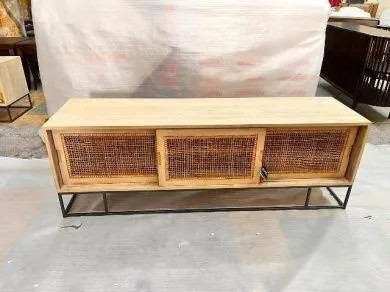
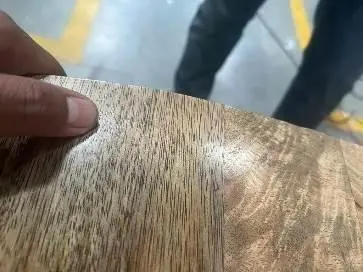
What we check on wooden sideboards
| Check | How it is checked | What fails |
|---|---|---|
| Door flatness | Straightedge on both diagonals of each door; door closed and the gap at each corner measured | Warp beyond the agreed limit; one corner standing off the carcass |
| Battens on slab doors | Screws checked for slotted holes that let the door move | Battens glued or screwed tight across the grain |
| Floating panels | Panel pressed at the edge to feel for movement; panel edge in the groove checked for finish | Panel glued in the frame, unfinished stripe at the panel edge |
| Grain and colour across fronts | All doors and drawer fronts viewed together against the approved sample and a sapwood rule | One front clearly lighter or darker, sapwood where it was not allowed |
| Wooden runners | Side clearance measured; each drawer run in and out; kicker above the drawer checked | No clearance, drawer binds, drawer drops when pulled out |
| Drawer boxes | Corner joints (dovetail, dowel or nail) and how the bottom is held | Nailed corners where dovetails were ordered, bottom loose in its groove |
| Hinge fixing in solid wood | Hinge screws checked for pilot holes and grip; door edge checked for splits | Stripped screws, split at a hinge, door sagging |
The inspector also takes moisture readings on doors and drawer fronts, not only on the carcass. A door made from wetter boards than the frame will move first.
Common wooden sideboard defects and how they are classed
| Defect | Class |
|---|---|
| Split in a leg or plinth carrying the cabinet | Critical |
| Door warped beyond the agreed limit | Major |
| Door panel glued in its frame and cracked | Major |
| Drawer binds on wooden runners | Major |
| Drawer tips down when pulled out (no kicker) | Major |
| Door sags from stripped hinge screws | Major |
| One front clearly out of the colour range | Major |
| Unfinished stripe at a panel edge | Minor |
| Glue squeeze-out inside a drawer | Minor |
These are our default classes for this product; your specification can set others.
Market rules that apply
A wooden sideboard carries the timber rules and the sideboard rules together. The ones to plan for:
- Australia. Sideboards and buffets 686 mm or taller need a permanent toppling warning label. See importing into Australia.
- United States. Dining room furniture is outside the STURDY Act. Every species, including plywood drawer bottoms, goes on the Lacey Act declaration, and plywood or MDF parts bring in TSCA Title VI.
- European Union. Wooden furniture is in scope of the EUDR. EU buyers often specify EN 14749 for storage units; see EN furniture testing.
Stability and strength tests are lab tests. The inspection checks labels, the parts list and visible build.
Packing, transit and loading risks
- Doors wrapped before the finish cures. A door sealed in plastic with damp lacquer on one face can cup in the container. Both faces of each door should be finished.
- Drawers swelling in transit. Wood-on-wood drawers that were a good fit in the factory can stick after weeks in a humid container. A rubbed-in wax on runners and a little extra clearance help; so does silica gel in the carton.
- Drawers left in the carcass. Drawers should be blocked or packed separately, so they do not slide and break their runners.
- Front faces. The doors face the carton wall. They need a sheet of foam the full length, not only corner blocks.
After the drop test the inspector re-runs every drawer and re-checks door flatness.
What to put in your purchase order
- Door construction (slab or frame-and-panel) and the maximum warp in millimetres.
- That panels float and are finished before assembly.
- A colour range and sapwood rule for fronts, ideally with photos of acceptable and unacceptable fronts.
- Runner type (wooden or metal), side clearance for wooden runners, kickers and stops.
- Drawer box joinery and drawer bottom material.
- Hinge type and that screws go into pilot holes, not end grain.
- Moisture target measured on doors and fronts as well as the carcass.
Comparing panel types? See cane sideboards and bone inlay sideboards. For the matching media piece, see wooden TV units.