What makes a wooden dining table different
Flatness, twist, wobble, seating clearance and extension slides apply to any dining table and are on the dining tables page. Moisture, species and filler policy apply to all timber and are on the solid wood furniture page. This page is about the joinery that makes a solid top and a wooden base work together.
A solid dining top is built in one of four ways:
- Edge-glued panel. Five to ten boards glued side by side. The width of each board, and how the boards are arranged, decides how much the top cups.
- Breadboard ends. A cross-grain strip on each end, fitted over a tongue or tenons. It keeps the top flat, but only works if the main top can still move across its width inside it.
- Battens underneath. Cross pieces screwed under the top to hold it flat, again with room for movement.
- Slab or live edge. One or two wide pieces, often with butterfly keys across natural cracks.
The base is usually four legs joined by an apron, by mortise and tenon or, on knock-down tables, by corner blocks and hanger bolts screwed into the legs.
From our inspections
Real photos from our published sample reports, anonymised. Click a source to read the full report.
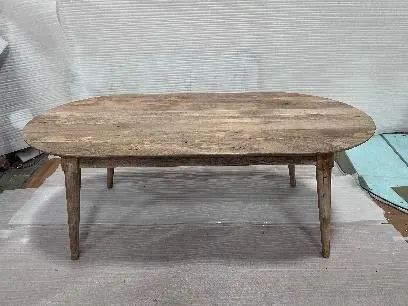
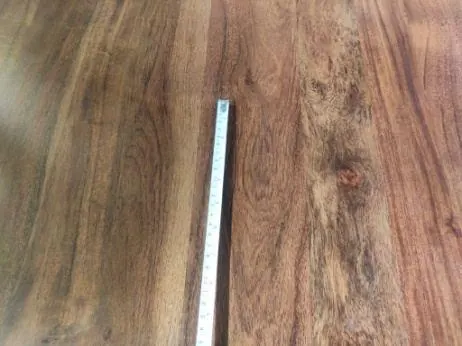
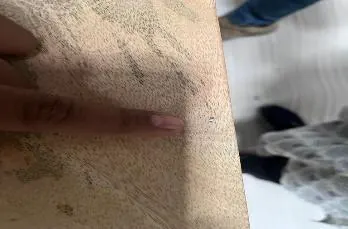
What we check on wooden dining tables
| Check | How it is checked | What fails |
|---|---|---|
| Board layout in glued tops | Board widths and count recorded from the end grain; glue lines checked along their length | Boards wider than specified, a short glue line, a board with heartwood pith in it |
| Breadboard ends | End strip checked for glue only at the centre and elongated peg holes at the outside; flushness with the top at both edges | End glued full width, top already cracked near the end, strip proud by more than the limit |
| Top-to-apron fixing | Underside checked for buttons, figure-8 fasteners or slotted holes | Screws through round holes across the grain, glue between top and apron |
| Leg-to-apron joints | Joint type against the drawing; leg racked by hand; on knock-down tables, hanger bolt and corner block checked after assembly | Joint moves, tenon shoulder gap, hanger bolt loose in the leg, corner block not seated |
| Butterfly keys and slab cracks | Keys checked for tight fit and depth; crack ends checked for growth past the key | Loose or shallow keys, crack running beyond the last key |
| Solid extension leaves | Leaf fitted; thickness step, colour and grain compared with the main top; moisture measured on leaf and top | Step at the joint, leaf a different shade, leaf wetter or drier than the top |
Common wooden dining table defects and how they are classed
| Defect | Class |
|---|---|
| Leg-to-apron joint loose or split | Critical |
| Hanger bolt pulls out of the leg | Critical |
| Breadboard end glued full width | Major |
| Top screwed tight across the grain | Major |
| End crack in the top | Major |
| Glue line opening along a board | Major |
| Leaf colour clearly different from the top | Major |
| Breadboard end slightly proud at one edge | Minor |
| Small step at the leaf joint, within limit | Minor |
End cracks are the defect we see most on solid dining tops. In Sample 03 (Jaipur, January 2023), one of six oval tops had an end crack, enough with a second rejected top to leave the lot Not cleared. A top that dries faster through its end grain than its faces cracks from the ends first. Sealing end grain and a fixing that lets the top move are the remedies.
Market rules that apply
- US, Lacey Act. Tops and bases are sometimes made from different species, and butterfly keys are often a contrasting wood. Every species must be on the declaration. See Lacey Act.
- EU, EUDR. Wooden tables are in scope; due diligence covers every timber in the table. See EUDR.
- EU buyers' tests. EN 12521:2023 covers strength, durability and stability of domestic tables. See EN furniture testing.
- Finishes. Lacquers, stains and oils on the top and base fall under REACH and may need a Prop 65 warning in California.
Packing, transit and loading risks
- Tops packed flat on an uneven base. A heavy solid top supported at two points can take a set in a hot container. Ask for full-face support.
- Breadboard ends. The end strip takes the impact if a top carton is dropped on its end. End blocks inside the carton protect the joint.
- Leaves stored apart. If leaves ship in a separate carton, label them to the table so they arrive together, and wrap them the same way as the top so they age the same.
- Hanger bolts. Knock-down legs with bolts fitted can be bent in the carton. Bolts should be in the hardware bag or protected.
What to put in your purchase order
- Top construction, maximum board width and number of boards.
- Breadboard end design: glued at the centre only, pegs in elongated holes.
- Top-to-apron fixing method and the number of fixings.
- Leg-to-apron joint type, and hanger bolt size and depth for knock-down legs.
- End-grain sealing before finishing.
- Leaves made from the same batch as the top, with a colour and step tolerance.
- Butterfly key species and depth, if used.
For a steel base under a wooden top, see metal and wood dining tables. For the matching bedroom pieces, see wooden beds.