Key takeaways
- Set the limit by where the furniture will be used. The USDA Wood Handbook recommends 8% average for interior furniture in most of the US, 6% in the dry southwest and 11% in damp coastal areas.
- A meter reading is an estimate. Set the meter for the species, correct for temperature, and use readings between about 6% and 30% only.
- Test several points on at least 10% of the pieces of each style, and record every reading, not just the average.
- Moisture content belongs in the inspection scope. In five of our six published furniture reports it was not in scope, so cracks could not be traced to it.
Why moisture content decides whether furniture cracks
Wood takes up and gives off water until it is in balance with the air around it. This balance point is the equilibrium moisture content (EMC). Below about 30% moisture, wood shrinks as it dries and swells as it takes up water, and it moves more across the grain than along it.
If a table is made from wood at 14% and then lives in a heated home where the wood settles at 8%, every board shrinks across its width. Glued panels split, mortise joints loosen, tops cup, drawers rattle and filler falls out of old cracks. The USDA Forest Products Laboratory's Wood Handbook gives this as the reason to install wood at the moisture content it will have in service: it avoids problems such as floor buckling or cracks in furniture.
The reverse also happens. Wood dried too far and sent to a humid climate swells, so doors and drawers bind. Both problems show up weeks after delivery, when the goods are already paid for.
From our inspections
Real photos from our published sample reports, anonymised. Click a source to read the full report.
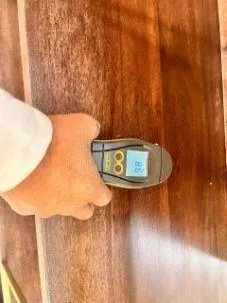
Moisture targets by destination climate
There is no single legal limit. The target comes from the climate where the furniture will be used. The clearest published reference is Table 13–2 of the Wood Handbook (FPL-GTR-282, 2021), which gives recommended values for interior woodwork and furniture in the United States:
| US climate area | Average | Individual pieces |
|---|---|---|
| Most areas | 8% | 6–10% |
| Dry southwestern area | 6% | 4–9% |
| Damp, warm coastal area | 11% | 8–13% |
The handbook adds that if the average is within 1% of the recommended value and every piece is within the individual limits, the lot is probably satisfactory. It also notes that furniture wood is commonly kiln dried slightly below the service level, because it picks up some moisture during processing and transport.
For other markets, apply the same logic to the indoor climate. Homes heated through a long winter, as in Canada and northern Europe, have dry indoor air in that season; homes in humid coastal climates sit higher. Clear To Load's working range is typically 8–11%, set by the destination's climate, with a default limit of 11% when the buyer gives none. If your market is dry, set a lower limit in the purchase order.
Pin and pinless meters: how readings are taken
Inspectors use hand-held electric meters, because the reference method (weighing a cut sample, oven drying it and weighing it again) destroys the piece. The Wood Handbook describes two types:
| Pin (resistance) meter | Pinless (dielectric) meter | |
|---|---|---|
| How it works | Two pins driven into the wood measure electrical conductance | A pad on the surface measures dielectric properties |
| Reliable range | About 6% to 30% | About 4% to 30% |
| What it reads | The wood at the pin tips (insulated pins) or the wettest point along the pins | Mostly the surface layers |
| Marks the piece | Yes, two small holes | No |
| Corrections | Species; temperature, about 0.5% per 10 °F (5.6 °C) away from the calibration temperature | Species or density setting; newer meters correct temperature internally |
Good practice on site:
- Use a meter with a calibration record, and check it on its reference block before starting.
- Set the species. Indian species such as mango, sheesham and acacia are not on every meter's list; use the maker's nearest setting and note it in the report.
- With pins, drive them about one-fifth to one-quarter of the thickness to read the average of the piece. If the reading rises as the pins go deeper, the core is wetter than the surface.
- Read hidden faces, legs and the middle of wide panels, not only the ends, which dry fastest.
- Treat readings above 30% as qualitative only.
The meter methods are standardised as ASTM D4444 and, in Europe, EN 13183-2 (resistance) and EN 13183-3 (capacitance), with EN 13183-1 as the oven-dry reference.
How many pieces to test, and how to report
The Wood Handbook advises testing at least 10% of each item for a realistic average, and several tests when the quantity is small. On an inspection this means several readings on every solid-wood style in the AQL sample, spread across different cartons and production batches.
A useful report records each reading by style and piece, the species setting, the wood temperature if far from the calibration temperature, the average and the highest reading, and the limit. Judge the lot on both: an average within the limit can hide single pieces that will crack.
In Sample 02 (Jaipur, 300 pieces of mirrors and cabinets), the inspector took moisture-meter spot checks on every style and all were within the limit. In the other five published reports, moisture was not in the agreed scope. Two of those lots, Sample 03 and Sample 04, failed on cracks in solid wood. We cannot say whether moisture caused them, because it was not measured. That is the argument for always including it.
Where moisture goes wrong in Indian production
- Air-dried timber. Smaller workshops may air dry rather than kiln dry. Air drying cannot reach indoor levels in humid weather.
- Monsoon storage. Kiln-dried wood stored in an open shed takes moisture back. The handbook recommends storing wood for furniture in a closed room or shed with controlled humidity.
- Machined parts left waiting. Ends of cut parts pick up moisture faster than the middle, so panels glued later can split at the ends.
- Wet finishing and packing. Packing straight after a water-based stain or finish can trap moisture inside the polybag.
- Transit. Dry lumber in a ship's hold usually takes up about 1.5% moisture on a normal voyage, according to the handbook. Furniture packed at the top of the limit can arrive above it.
For the drying process itself, see kiln drying.
What to put in your purchase order
- Maximum moisture content per piece, and target average, for each solid-wood style.
- Meter type and the species setting to use; oven-dry test by a lab if readings are disputed.
- Number of readings per piece and pieces per style.
- Kiln-drying record from the timber supplier or the factory's own kiln.
- What happens to pieces over the limit: re-drying and re-inspection, not shipment.
Moisture content is check C-02 on the Clear To Load furniture inspection checklist. Make sure it is in the scope and tell us your limit when you book. See also solid wood furniture inspection and how to inspect furniture before shipping.
Sources
- USDA Forest Products Laboratory, Wood Handbook (FPL-GTR-282, 2021), Chapter 13: Drying and Control of Moisture Content and Dimensional Changes
- EN 13183-2:2002, Moisture content of a piece of sawn timber, Part 2: Estimation by electrical resistance method (BSI)
- Clear To Load sample inspection reports (six anonymised furniture inspections, 2022–2023)