Key takeaways
- Write a packing specification: carton board, inner protection, maximum gross weight, marks and the drop test. An inspector can only judge packing against a standard you set.
- ISTA 2C is the ISTA procedure written for packaged furniture. Choose 1A, 3A, 3B or 3E instead when the weight or the shipping route calls for it.
- ISTA testing and certification happen in a lab. An on-site drop test by an inspector is a useful screen, not an ISTA result.
- Decide before testing what counts as damage. ISTA asks the shipper to do the same.
What a furniture packing specification should cover
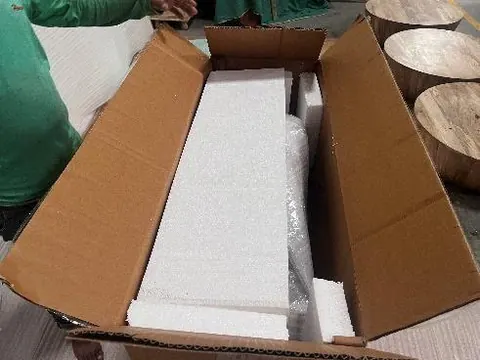
Most transit damage to furniture comes from a few points: corners, edges, legs, glass and stone tops, and anything that can move inside the carton. A packing specification closes those points before production, so the inspector has something to check against.
| Item | What to specify | What the inspector checks |
|---|---|---|
| Outer carton | Board ply and flute (for example 5-ply or 7-ply), board grade, style, internal size | Ply at the cut edge, box maker's certificate, fit of the product |
| Corners and edges | Corner protectors of a named material and size on every corner; edge boards on long cartons | Present on every corner of the sampled cartons |
| Surface protection | Polybag or foam sheet, foam thickness, face boards over tops, glass and mirrors | Finish not touching the board; no rub marks |
| Movement | Blocks or foam that stop the product shifting; doors and drawers secured | Shake test; nothing loose inside |
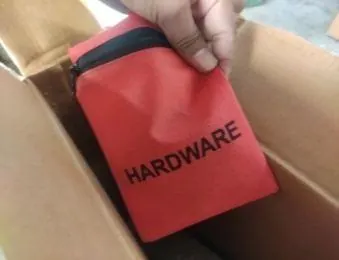
| Separate parts | Legs, glass and fittings packed separately and fixed in place | Fittings bag present, labelled and fixed |
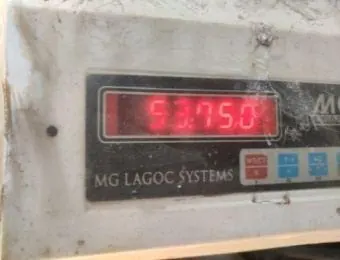
| Weight | Maximum gross weight per carton, and two-person handling marks above it | Carton weighed on a scale |
| Marks | Shipping marks, handling symbols, barcodes, country of origin | Against the artwork; barcodes scanned |
| Wood packaging | Pallets and crates treated and marked to ISPM 15 | Mark present and legible |
In Sample 01 (Jodhpur, 181 pieces) the buyer had not supplied a packing, carton or shipping-mark specification, so the inspector could only record what was there. The cartons were in good condition, carton edge protection was photographed and barcodes were scanned, but nothing could be judged against a standard.
From our inspections
Real photos from our published sample reports, anonymised. Click a source to read the full report.
Which ISTA procedures apply to furniture
The International Safe Transit Association (ISTA) publishes transit test procedures in series: 1 (non-simulation integrity), 2 (partial simulation), 3 (general simulation), 4 (enhanced simulation), 6 (member procedures written for a particular supply chain, such as a retailer's) and 7 (development). For furniture, these are the usual choices:
| Procedure | Scope, from ISTA | When it fits furniture |
|---|---|---|
| ISTA 2C | Partial simulation for individual packaged furniture (case goods). ISTA notes it can be used for any furniture transported in a container. | The default choice for boxed furniture shipped by container |
| ISTA 1A | Integrity test for individual packages of 150 lb (68 kg) or less | Basic screening of a new carton design |
| ISTA 1B / 1E | Integrity tests for packages over 150 lb, and for unitized loads | Heavy single pieces, or pallets |
| ISTA 3A | General simulation for packages of 70 kg (150 lb) or less sent by parcel carrier | Furniture sold online and sent to the consumer by parcel |
| ISTA 3B | General simulation for less-than-truckload (LTL) shipments | Furniture that travels on shared trucks after the container is unloaded |
| ISTA 3E | Unitized loads of similar products on a full truckload | Palletized furniture going to a distribution centre |
ISTA 2C runs atmospheric preconditioning, optional temperature and humidity conditioning, random vibration under a calculated top load, and a shock test: a drop, or an incline or horizontal impact, at a level that depends on the packed weight and the distribution channel. ISTA requires one run and recommends five or more, each on a new sample.
Two points matter for buyers. First, ISTA asks the shipper to define before the test what counts as product damage and package damage, and how condition will be judged. Second, to use the ISTA mark or claim certification, the test must be done in an ISTA-certified lab. If your retailer names a specific procedure, such as one from the 6 series, use that one.
The on-site carton drop test
At the factory, the inspector takes packed cartons from the random sample and drops them onto a hard floor. Many inspection checklists use one corner, three edges and six faces. The drop height should come from your specification; like the ISTA procedures, it is usually set by the carton's gross weight.
After the drops, the inspector opens the carton and checks:
- Breakage, cracks or dents in the product, especially corners, legs and tops.
- Finish damage where the product touched the carton or its protection.
- Movement inside the carton, crushed corner protectors, burst seams.
- Function after the drop: doors still hang true, drawers run, the frame has not racked.
An on-site drop test has no vibration, conditioning or compression, and the floor and height are not controlled as in a lab. It finds weak packing early, at low cost. It does not replace an ISTA test, and a report should never call it one.
Weights, heavy cartons and packaging records
Carton weight drives both the drop height and the risk of rough handling. Our published reports record real weights: in Sample 02 carton weights for all eight styles ranged from 24.80 to 65.40 kg, and in Sample 03 gross carton weights of 24.95, 53.75 and 56.65 kg were checked on the scale. Cartons in the 50–65 kg range are two-person lifts; mark them as such, and check that hand-holds or straps do not tear.
On request, our inspectors also weigh sampled units and their packaging by material, such as cartons, plastics and fillers, against your packaging specification. This supports packaging EPR or Plastic Packaging Tax reporting. It is an add-on to the inspection, not a separate certification.
After packing: crates, pallets and loading
Marble tops, mirrors and large glass often travel in wooden crates or on pallets. Any solid-wood packaging needs ISPM 15 treatment and the mark; see ISPM 15. Plywood and other processed wood are outside ISPM 15.
Good cartons still fail if they are forced into gaps or loaded under heavier goods. A loading supervision checks carton condition, stacking, heavy-at-the-bottom and the container seal. See also the container loading checklist.
Sources
- ISTA test procedures (series and scopes)
- ISTA 2C overview: Furniture Packages
- ISTA 1A overview: Packaged-Products 150 lb (68 kg) or Less
- ISTA 3A overview: Packaged-Products for Parcel Delivery System Shipment
- ISPM 15, Regulation of wood packaging material in international trade (IPPC)
- Clear To Load sample inspection reports (six anonymised furniture inspections, 2022–2023)