Lab test and on-site check
| Lab stability test | On-site tip-over check | |
|---|---|---|
| Purpose | Proves compliance with a standard | Screens production units for an obvious hazard |
| Method | Full method of the standard: set loads, set floor angle, all extendible parts open | Unit on a level floor, all drawers and doors open, with any load the buyer's protocol sets |
| Result | Test report from an accredited lab | Pass or finding in the inspection report, with photos |
Under the US STURDY Act, 16 CFR 1261 makes ASTM F2057-23 mandatory for clothing storage units made from 1 September 2023 that are free-standing, at least 27 in tall, at least 30 lb and at least 3.2 cubic feet of enclosed storage. The test simulates carpet by tilting the unit, and a tip restraint and a permanent warning label are required. Australia requires toppling warnings on storage furniture 686 mm or taller and on all TV units, but that is a labelling rule, not a stability test.
From our inspections
Real photos from our published sample reports, anonymised. Click a source to read the full report.
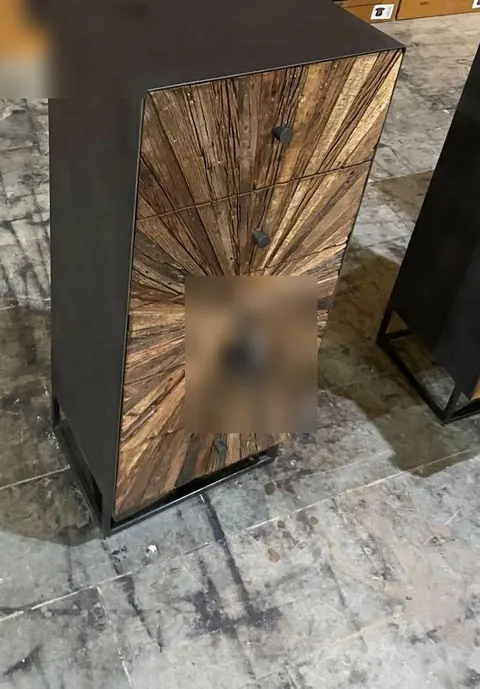
Worked example from a real inspection
In our mango wood furniture report from Jodhpur, a five-drawer wood and iron cabinet tipped forward when every drawer was opened, with no provision for an anti-tip kit. A tip-over hazard is a critical defect, so that single finding put the whole lot at Not cleared. The factory needed a design change or an anti-tip kit before shipment, and for the US market the unit falls under the STURDY Act.
How Clear To Load uses it
On chests, wardrobes, bookcases and TV units the inspector opens every drawer and door on sampled units and checks whether the unit tips, and checks for the anti-tip kit and warning label where your market requires them. That is a screen. Compliance testing goes to an ISO/IEC 17025-accredited lab that you choose or that we suggest, through lab testing coordination. See chests of drawers and TV units.