The three kinds of mark
| Kind | Typical content | Why it matters |
|---|---|---|
| Main marks (front) | Buyer's initials or logo, destination port, PO number, carton number as "12 / 40" | Matches the carton to the bill of lading and packing list |
| Side marks | Item code and description, quantity per carton, net and gross weight, carton dimensions, barcode | Lets the warehouse receive without opening cartons |
| Handling marks | Symbols such as this way up, fragile, keep dry, from ISO 780 | Tells handlers how to treat the carton |
"Made in India" on the carton is often required as well; see country-of-origin marking.
From our inspections
Real photos from our published sample reports, anonymised. Click a source to read the full report.
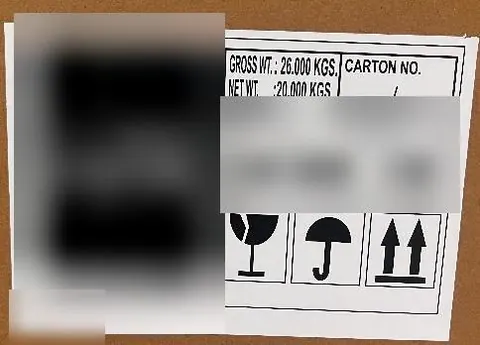
Worked example: one carton of cushion covers
The buyer's artwork for PO 4518 asks for: brand logo; HAMBURG; PO 4518; C/NO 1–40; item CC-201, 50 pcs, 45 × 45 cm; N.W. 9.0 kg, G.W. 10.2 kg; this-way-up and keep-dry symbols; MADE IN INDIA; EAN barcode on two sides.
At inspection, carton 17 reads "C/NO 17/38" because the factory packed 38 cartons, not 40. The packing list says 40. Either the mark or the count is wrong, and the inspector reports which. A barcode that does not scan, or a gross weight 2 kg off the scale reading, is recorded the same way. Small marking errors cause real delays at a distribution centre, so many buyers class them as major defects.
How Clear To Load uses it
Send your marking artwork with the booking. The inspector checks marks on sampled cartons against it, scans barcodes, weighs cartons and photographs each face. In our Jodhpur solid wood report, the buyer had not supplied a marking specification, so the inspector recorded the marks as found and scanned the barcodes, which passed. A marking difference from your specification leads to Hold for your decision.